
You step into the shower, reach for the handle, and brace for a blast of ice-cold water that completely derails your morning. It’s a stressful realization to think, “I have no hot water in my house,” especially when you have a family to get ready and a busy day ahead. We understand that this isn’t just a minor inconvenience; it’s a disruption to your comfort and a source of real anxiety regarding potential repair costs or safety risks. As your local neighbors, we know how Florida’s hard water and humidity can quietly wear down even the most reliable systems.
This guide helps you identify exactly why your system failed and provides clear steps to take next. You’ll learn how to spot simple fixes you can handle yourself and when it’s vital to call a professional specialist to ensure your home remains safe and tidy. We’ll walk through common regional issues like mineral buildup and electrical component failure, giving you a clear understanding of the path to warm showers again. By the end, you’ll have a plan to restore your hot water and the peace of mind that comes with expert guidance.
Key Takeaways
- Perform an immediate safety check using the “Smell Test” to rule out gas leaks before you begin any manual troubleshooting.
- Follow a simple diagnostic checklist to use when you think, “I have no hot water in my house,” to see if the problem is a single fixture or a system-wide failure.
- Learn the tell-tale differences between electric heating element failure and gas burner issues to help you decide when a DIY fix is safe.
- Discover how Florida’s specific hard water minerals can cause sediment buildup, leading to the common “popping” sounds that signal your tank is struggling.
- Recognize five critical emergency signs, including active puddles and discolored water, that mean it is time to call a local specialist for a tidy, professional repair.
Immediate Steps: Safety Checks and Simple Fixes
Walking into a cold shower is a jarring way to start your day. When you realize “I have no hot water in my house,” your first instinct might be to worry about an expensive replacement. However, many issues are simple to identify and occasionally easy to fix with a few basic checks. Before you call for a repair, start by determining if the problem is isolated. Check every hot water tap in your home. If you have hot water in the kitchen but not the master bath, the issue likely lies with a specific faucet or mixing valve rather than your water heater.
Realizing “I have no hot water in my house” is a major disruption to your routine, but staying calm and following a methodical safety check is the best way to get things back to normal. If the water is cold at every faucet, you’ll need to look at the power or fuel source for the heater itself.
The Rotten Egg Rule: Gas Safety 101
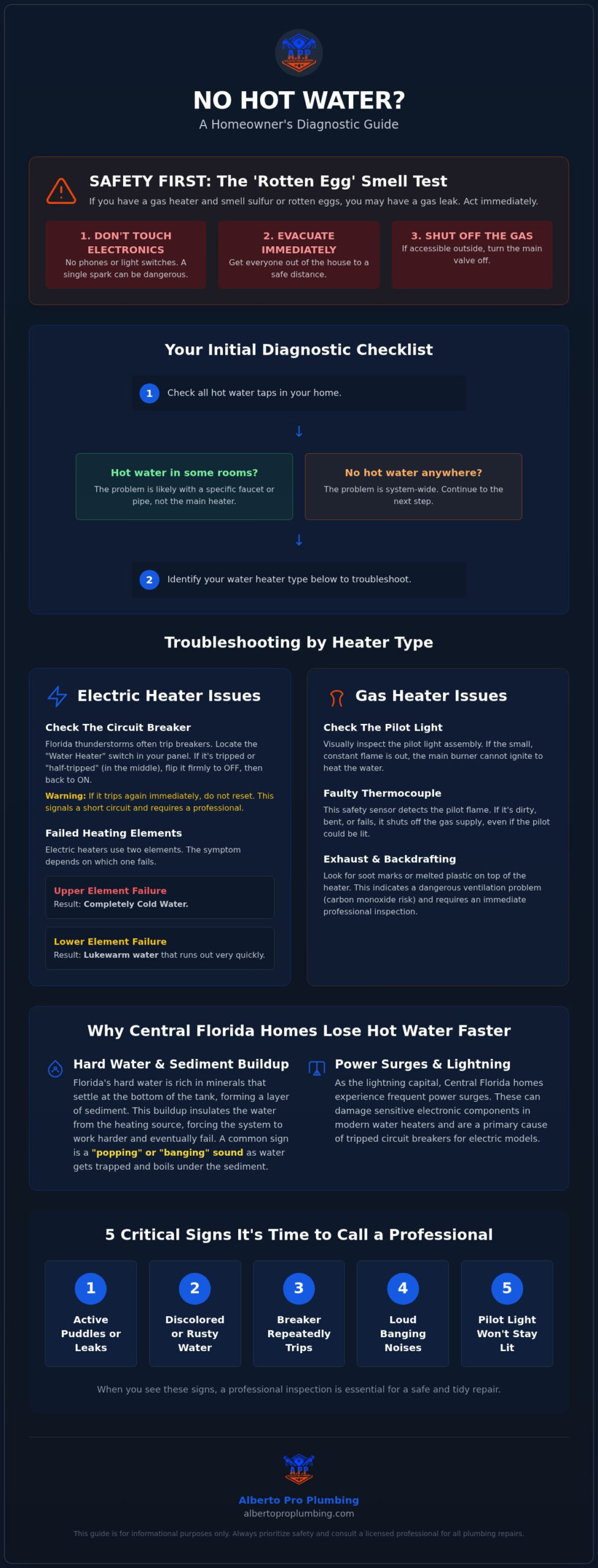
If you use a gas water heater, safety is your absolute priority. Natural gas is odorless, so utility companies add a chemical called mercaptan to give it a distinct, sulfur-like smell similar to rotten eggs. If you detect this scent, do not ignore it. A gas leak is a serious emergency that requires immediate action to protect your family and property.
- Do not touch anything electrical: Avoid using your phone, flipping light switches, or even unplugging appliances, as a tiny spark could ignite the gas.
- Evacuate immediately: Get everyone out of the house and leave the door open to help ventilate the space while you move to a safe distance.
- Shut off the gas: If the main gas valve is accessible outside your home, use a wrench to turn the valve a quarter turn until the handle is perpendicular to the pipe.
Electric Water Heater Quick-Checks
For most Florida homeowners, electric units are the standard. Because Central Florida is the lightning capital of the country, power surges during our frequent afternoon thunderstorms often trip the dedicated breaker for your water heater. Head to your electrical panel and look for the switch labeled “Water Heater.”
Sometimes a breaker looks like it is still on when it has actually “half-tripped.” This means the switch is stuck in a middle position between on and off. To fix this, you must firmly flip it to the “Off” position first until you hear a click, then flip it back to “On.” If the breaker trips again immediately, do not keep resetting it. This is a clear sign of a short circuit or a grounded heating element that requires a professional inspection to prevent a potential fire hazard.
Finally, if you have a gas unit and don’t smell a leak, perform a quick visual inspection of the pilot light. If the flame is out, your water will stay cold regardless of your settings. Understanding how water heaters work can help you visualize how that small flame or electrical element is responsible for your comfort. If these basic steps don’t solve the problem, it’s time to look deeper into specific component failures.
Troubleshooting Gas vs. Electric Water Heater Failures
Identifying the power source of your unit is the first critical step when you realize, “I have no hot water in my house.” While both systems store water in an insulated tank, the way they transfer heat is fundamentally different. Gas heaters use a burner assembly located underneath the tank, venting exhaust through a flue. Electric models use two internal heating elements that sit directly in the water. Understanding these components helps you narrow down why your morning routine was interrupted.
Gas Unit Specifics: Pilot Lights and Thermocouples
Gas units rely on a small flame called a pilot light to ignite the main burner. A common culprit for failure is the thermocouple, a safety sensor that detects the pilot’s heat. If this sensor is dusty, bent, or worn out, it won’t signal the gas control valve to open, and your water stays cold. You should also look for signs of backdrafting, such as soot or melted plastic caps on top of the unit. This indicates exhaust gases are not escaping correctly, which is a significant carbon monoxide hazard that requires an immediate professional inspection. The gas control valve itself can also fail, preventing the burner from receiving fuel even if the pilot is lit.
Electric Unit Specifics: Elements and Thermostats
Electric water heaters are the most frequent choice for Central Florida homes. If you find that your water is only lukewarm rather than completely cold, you likely have one failed heating element. These units typically have an upper and lower element. When the upper one fails, you get no hot water at all; when the lower one goes, you simply run out of hot water much faster than usual.
- The Reset Button: Most electric units feature a red high-limit reset button behind the access panel. If this button has popped out, it indicates the unit overheated and shut itself down for safety.
- Testing for Continuity: Professionals diagnose element health by testing for continuity. This involves using a multimeter to see if the electrical path inside the element is broken.
- Thermostat Sync: Electric units have two thermostats. If they aren’t communicating correctly, one element might stay on too long or not turn on at all.
Finding the right thermostat setting is a balance between safety and comfort. We recommend keeping your heater set to 120 degrees Fahrenheit. This temperature is hot enough to kill bacteria while remaining safe enough to prevent accidental scalding. If you’ve adjusted your settings and still find yourself saying, “I have no hot water in my house,” it’s often more cost-effective to have a professional diagnose the internal components. For a thorough system check that keeps your home running smoothly, consider our Water Heater Installation and repair services to get your showers warm again without the guesswork.
5 Signs It’s Time to Call a Professional Plumber
While basic checks solve simple problems, certain symptoms signal that your water heater has reached its limit. If you have already investigated the power source and the pilot light but are still thinking, “I have no hot water in my house,” you might be facing a terminal system failure. Knowing when to stop troubleshooting and call for help can save you from expensive water damage or serious safety hazards. Here are the five critical signs that your unit requires expert attention.
- The 10-Year Milestone: Traditional tank water heaters in Florida typically last between 8 and 12 years. If your unit is past a decade of service, the internal components are likely corroded beyond simple repair.
- Metallic or Rusty Water: If your hot water looks brown or smells like pennies, the internal lining of your tank is likely disintegrating.
- Popping and Rumbling Noises: These sounds indicate that thick layers of sediment have hardened at the bottom of the tank, causing the unit to overheat and struggle to transfer heat.
- Active Puddles: Any moisture around the base of the tank is a major red flag. Research shows that 69 percent of water heater failures result from slow leaks or bursting.
- Inconsistent Temperatures: If your water fluctuates between freezing and scalding without anyone touching the dial, the internal thermostats or heating elements have failed.
Identifying Tank Corrosion and Leaks
It is vital to distinguish between a loose pipe fitting and a breached inner tank. A leaking fitting is a quick fix, but if water is seeping through the insulated jacket of the heater, the internal tank has likely cracked. This often happens when the sacrificial anode rod, which is designed to attract corrosive elements, has completely dissolved. In Florida’s humid climate, a small leak can quickly lead to mold growth or a flooded garage if the tank finally gives way. If you notice rust only in your hot water lines, it is a definitive sign that the heater itself is the source of the problem.
When DIY Becomes Dangerous
Home maintenance is rewarding, but water heaters involve high-voltage electricity and pressurized gas. Working with 240V electrical circuits without proper training can lead to severe shocks or house fires. Similarly, gas valve replacements are never a recommended DIY project because even a tiny misalignment can lead to a gas leak or carbon monoxide buildup. If you are unsure about the safety of your unit or if the troubleshooting steps have failed, our team is ready to help. You can reach out through our Emergency Plumbing Repair page for immediate, professional assistance. We pride ourselves on providing a tidy service that respects your home while getting your hot water restored quickly.
Why Central Florida Homes Lose Hot Water Faster
Living in Central Florida brings specific environmental challenges that most generic plumbing guides simply don’t address. If you find yourself frustrated because “I have no hot water in my house,” the culprit is often the very ground we walk on. Our region’s water is notoriously hard, packed with calcium and magnesium from our limestone aquifers. These minerals don’t just stay in the water; they settle and solidify inside your plumbing appliances, leading to premature failure compared to units in other parts of the country.
Humidity also plays a quiet but destructive role. In Lake and Orange Counties, the moisture in the air accelerates the corrosion of external fittings, valves, and the outer casing of your heater. This constant environmental pressure means a unit that might last 12 years elsewhere often struggles to reach its tenth birthday here. Understanding these local stressors helps you move past the “I have no hot water in my house” crisis and toward a more resilient solution for your family.
The Impact of Hard Water on Heating Elements
In an electric water heater, minerals undergo a process called scaling. This is where calcium “cooks” onto the hot metal heating elements, creating a thick, crusty layer of insulation. As this scale grows, the element has to work twice as hard to reach the same temperature, eventually burning itself out from the inside. In gas units, this sediment settles at the bottom of the tank, creating a barrier between the burner and the water. This leads to the “popping” or “sand” sound you might hear. It’s actually steam bubbles trapped under a layer of sediment, struggling to escape. To fight this, we strongly recommend an annual flush of your system to remove these minerals before they can cause permanent damage.
Lightning and Your Water Heater
Because we are locally owned and operated, we see the results of Florida’s unique climate every single day. We don’t just swap parts; we provide solutions that account for our local water chemistry and weather patterns. Our team takes pride in offering a tidy service, ensuring that once we restore your comfort, your home is left exactly as we found it. If you’re tired of dealing with local water issues, learn more about our Water Heater Installation options designed specifically for the Central Florida environment.
Professional Solutions: Getting Your Hot Water Back Today
When you realize I have no hot water in my house, you need more than a quick fix; you need a permanent solution that respects your time and your budget. Alberto Pro Plumbing approaches every call with a diagnostic mindset. We don’t just look for the failed component; we look for the environmental factors, such as the mineral scaling or electrical issues discussed earlier, that caused the failure in the first place. This ensures that the repair we perform today prevents another cold shower next month.
Our diagnostic process provides you with honest, neighborly advice on the most cost-effective path forward. If your unit is under eight years old and the tank is structurally sound, a repair is often the best choice. However, if the internal lining is breached or the unit has reached that critical ten-year mark, we’ll explain why a replacement is the safer investment. We believe in building trust through transparency, ensuring you never pay for a service you don’t actually need.
Expert Water Heater Repair and Installation
We don’t believe in one-size-fits-all solutions for Central Florida homes. Our Water Heater Installation services focus on units specifically designed to handle our local water chemistry and humidity levels. Because we serve Lake, Polk, Osceola, and Orange Counties, we maintain a fleet ready for 24/7 emergency response. Whether you are in Clermont or Orlando, our technicians arrive equipped with the specialized tools and parts needed to restore your comfort on the first visit.
The Alberto Pro Plumbing Difference
This proactive approach is at the heart of our Plumbing Membership, which is designed to protect your home year-round. This membership includes essential preventative care, like the annual water heater flushes required to combat the hard water minerals that “cook” onto your elements. By catching small issues during a routine check, we help you avoid the stress of thinking, “I have no hot water in my house,” during a busy work week.
Restoring your hot water is only half of our job. We take immense pride in our tidy service promise, ensuring that our workspace is left in its original condition. We respect your property, wear protective floor coverings, and clean up thoroughly before we leave. If you’re ready to stop troubleshooting and start enjoying warm showers again, Contact Alberto Pro Plumbing today for immediate, professional restoration.
Restore Your Home’s Comfort Today
Dealing with a cold shower is stressful, but understanding the local impact of hard water and the simple safety checks available can help you regain control. Whether it’s a tripped breaker from a storm or sediment buildup from our Central Florida aquifers, you now have the tools to diagnose the problem. If you’re still thinking, “I have no hot water in my house,” don’t let the frustration linger or risk a dangerous DIY repair on complex gas or electrical components.
As a local, Clermont-owned and operated business, we’re genuinely invested in our community’s well-being. We offer a tidy service guarantee, ensuring your home remains spotless while we work. With our 24/7 emergency service available, you never have to wait through a cold weekend for a professional solution. Need hot water now? Call the Clermont experts at Alberto Pro Plumbing! We’re here to provide the reliable, expert care your family deserves to get those warm showers back immediately.
Frequently Asked Questions
How do I reset my electric water heater?
You can reset your unit by pressing the red high-limit reset button located behind the access panel on the side of the tank. First, turn off the power at the breaker for safety. Remove the panel screws, move the insulation aside, and press the button firmly until it clicks. If the button pops back out immediately, it indicates a serious electrical fault that requires a professional inspection.
Is it dangerous if I have no hot water but plenty of cold water?
Having cold water while the rest of your plumbing works is usually not dangerous, but it does mean your heating source has failed. The danger only arises if the failure is caused by a gas leak or a high-voltage electrical short. Always check for the scent of rotten eggs or scorched wires. If you detect either, leave the area and call for emergency assistance immediately.
Why is my hot water taking so long to reach the shower?
This delay is typically caused by the distance between your water heater and the shower. In many local homes, the heater is located in the garage, meaning the hot water must push out all the cooled water sitting in the pipes first. If this wait is a daily frustration, we can install a recirculation pump. This system keeps hot water moving through your pipes for nearly instant results.
Can a bad thermocouple cause no hot water in a gas heater?
Yes, a malfunctioning thermocouple is one of the most common reasons a gas water heater stops working. This safety device detects the heat from the pilot light and signals the gas valve to stay open. If the thermocouple is bent, dirty, or worn out, it won’t detect the flame. The system will then shut off the gas supply as a safety precaution, preventing the burner from firing.
How much does it typically cost to fix a water heater in Florida?
The cost of a repair depends entirely on which component has failed and the overall condition of your unit. Simple fixes like replacing a thermostat or a single heating element are much more affordable than replacing the entire tank. We provide a thorough diagnostic process to identify the root cause. This ensures you receive an honest recommendation on whether a repair or a full replacement is the most cost-effective path.
What should I do if my water heater is making a loud rumbling noise?
You should schedule a professional tank flush to remove the sediment buildup at the bottom of your unit. That rumbling or popping sound happens when water gets trapped beneath a layer of hardened minerals. As the water heats up, it turns into steam and “pops” through the sediment layer. This process is hard on your tank and significantly reduces its energy efficiency over time.
How long does a standard water heater last in Central Florida?
A standard tank water heater in our region typically lasts between 8 and 12 years. Florida’s hard water minerals and high humidity levels often lead to internal corrosion faster than in other states. If your unit is over a decade old and you find yourself saying, “I have no hot water in my house,” a replacement is often a more reliable long-term investment than a repair.
Will a tripped breaker cause my water to be lukewarm or completely cold?
A tripped breaker will result in completely cold water because it cuts all power to the heating elements. If you notice your water is lukewarm, it usually means only one of your two heating elements has burned out. This is a common situation when I have no hot water in my house that meets my family’s needs. We can quickly test these elements and replace the failed one to restore your comfort.