
Could Florida’s water conditions mean your tankless water heater needs attention sooner than you think? Mineral scale can build up inside a unit and affect its operation, especially where water is hard. Tankless water heater maintenance Florida homeowners plan should follow the manufacturer’s instructions and account for the water supplied to their home, rather than rely on a one-size-fits-all schedule.
It’s common to wonder how often to flush a system, what upkeep you can handle yourself, and whether a change in hot-water performance calls for maintenance or repair. The manual is the best starting point because recommended procedures and intervals vary by model. Keep track of symptoms and service history, too, so you can describe what has changed.
This guide covers common maintenance considerations, how water conditions can affect upkeep, and how to prepare for a professional assessment. Alberto Pro Plumbing provides Water Heater Repair (tank and tankless) for homeowners in Clermont, Florida, and across Lake County, Polk County, Osceola County, Orange County. All plumbers are licensed and insured.
Key Takeaways
- Plan tankless water heater maintenance Florida homeowners need around the unit’s manual and relevant information about the home’s water, not a universal schedule.
- A plumber can assess the unit and discuss whether cleaning or flushing is appropriate for its model and condition.
- Compare the manual’s guidance, known water conditions, and changes in operation when deciding whether to arrange an assessment.
- Prepare by gathering model details, noting symptoms or error messages, reviewing prior service, and making the unit accessible.
- Alberto Pro Plumbing provides Water Heater Repair (tank and tankless) in Lake County, Polk County, Osceola County, Orange County. All plumbers are licensed and insured.
Why tankless water heater maintenance matters in Florida homes
Tankless water heater maintenance is care guided by the manufacturer that helps keep the unit in proper working order. The tasks depend on the model and water conditions, and maintenance cannot prevent every repair.
Heating water on demand doesn’t make a tankless unit maintenance-free. Minerals in the water supply can contribute to scale inside the unit over time. Depending on the system and conditions at home, buildup may affect water flow or operation. Routine attention can help identify maintenance needs before they are mistaken for an active fault.
The overview of Tankless Water Heater discusses scale buildup as one consideration for these systems. The practical point for homeowners is to avoid assuming every unit needs the same task at the same interval. Follow the guidance for your specific model and consider relevant information about the water supplied to your home.
What routine tankless water heater maintenance is designed to address
Maintenance may include checking the unit for signs of buildup, restricted flow, or other conditions that could call for cleaning or flushing. The appropriate work depends on the model, its manual, and the unit’s observed condition. An inspection can help establish whether routine care is suitable or whether a performance issue needs troubleshooting.
Preventive care and diagnosing a malfunction are different tasks. If the heater displays an error message, produces inconsistent hot water, or operates differently than usual, record what you notice and share it with a plumber. Don’t assume that a routine cleaning or flush will resolve the cause.
Why Florida homeowners should avoid a one-size-fits-all schedule
Water characteristics can vary by locality and household, so “Florida water” isn’t one uniform condition. Your water supply may influence how quickly mineral deposits develop, but a regional generalization can’t replace the manual or information about your home. Tankless water heater maintenance Florida homeowners plan should be based on the specific unit and relevant local water-quality information.
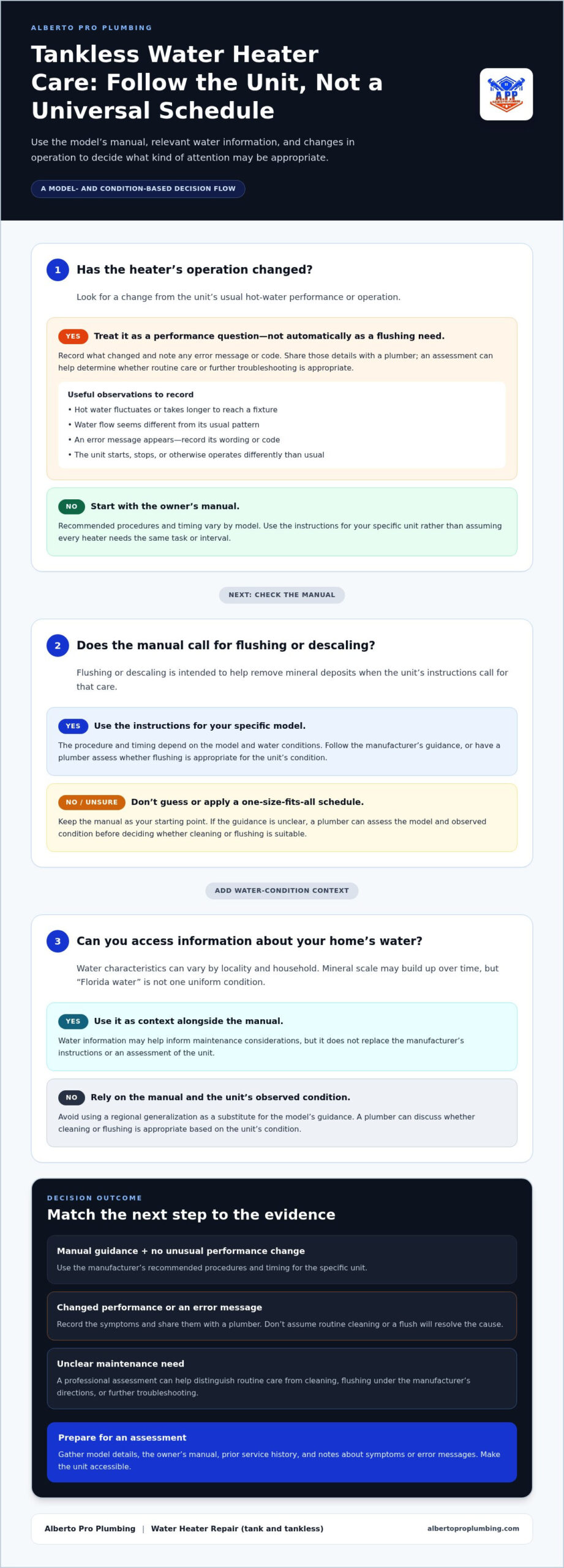
Start with the owner’s manual for recommended procedures and timing. If you can access water-quality information for your home, use it as context rather than as a substitute for the manual. A plumber can assess the unit and discuss whether cleaning or flushing is appropriate based on its model and condition.
Keep the manual and service history handy so you know what the manufacturer recommends. If you notice a change in performance, describe it clearly and have the unit assessed instead of guessing at the cause.
Tankless water heater maintenance tasks: what a service visit may cover
A tankless maintenance visit isn’t a fixed checklist for every heater. The work depends on the model, its manufacturer’s instructions, and the unit’s condition. The purpose of an assessment is to determine which maintenance tasks apply, rather than automatically performing the same procedure on every system.
For tankless water heater maintenance, use the manual as your starting point and note any changes in performance. If hot water has become inconsistent or the display shows an error, mention it when arranging service. A symptom may call for troubleshooting rather than routine cleaning alone.
Flushing and descaling: when the manufacturer’s instructions call for it
Flushing or descaling is intended to help remove mineral deposits from parts of the water-heating pathway when the unit’s instructions call for that care. The procedure and timing vary by model and water conditions. Follow the manual for your specific unit, or have a plumber assess whether flushing is appropriate. Don’t assume every tankless heater needs the same treatment.
Inspecting filters, connections, and visible operation
A plumber can review accessible components in line with the unit’s instructions and the service findings. If the manual calls for attention to an inlet filter, that may be part of the maintenance discussion. Any review of gas connections, venting, or electrical components depends on the heater type and the professional’s scope of work. Follow the manufacturer’s homeowner guidance, and leave other inspection or maintenance procedures to a qualified professional.
Before an appointment, note what has changed. Specific observations help distinguish a maintenance question from a possible repair:
- Hot water fluctuates or takes longer to reach a fixture.
- Water flow seems different from its usual pattern.
- An error message appears on the unit’s display. Record the wording or code.
- The unit starts, stops, or otherwise operates differently than usual.
These details don’t diagnose the cause, but they give a plumber useful context. An error message doesn’t prove the unit needs descaling. An assessment can help determine whether the next step is routine care, cleaning or flushing under the manufacturer’s directions, or further troubleshooting.
Alberto Pro Plumbing provides Water Heater Repair (tank and tankless). If the unit’s performance has changed, share the symptoms and any error messages so the plumber can assess whether repair is needed. All plumbers are licensed and insured. To discuss a tankless water heater problem, contact Alberto Pro Plumbing.
How Florida water conditions affect maintenance timing
There isn’t one maintenance calendar that fits every tankless water heater in Florida. Water conditions vary by locality and household, and the unit’s design affects what care it needs. Use the manufacturer’s instructions alongside reliable information about your home’s water. A plumber can consider both when assessing the heater.
For tankless water heater maintenance, treat local water information as context, not a stand-alone schedule. Don’t assume a nearby community has the same water characteristics as your home, or that a broad state-level description determines when the unit needs service. Follow the manufacturer’s timing or have a qualified plumber assess the heater.
Use the manual and local water information to plan upkeep
Find the model details on the heater or in your paperwork, then look up the maintenance section in its manual. Note the manufacturer’s recommended tasks, timing, and any instructions related to water conditions. If the manual is missing, use the model information to find the correct documentation instead of following guidance for another unit.
For local water context, consult reliable information from the water utility or another relevant local water-quality source. A plumber can consider that information alongside the manual and the heater’s condition. This is more useful than applying a schedule simply because it’s common advice online.
| What you know | What to consider | Practical next step |
|---|---|---|
| Manual guidance | The stated maintenance tasks and timing for this model | Use the manufacturer’s instructions as the starting point |
| Local water information | Whether available data indicates water characteristics relevant to the manual’s guidance | Keep the source and findings with the heater records |
| Observed unit changes | Any shift in hot-water consistency, flow, display messages, or operation | Record what changed and when, then arrange an assessment if it persists |
| All three together | How the manual, water information, and actual performance fit together | Follow the manual or have a qualified plumber assess the appropriate interval |
Changes in performance that merit attention
Report changes clearly, but don’t diagnose the cause from one symptom. Inconsistent hot water, reduced flow, an unusual display message, or recurring interruptions are useful observations for a plumber. Note when the issue occurs and whether it repeats. These details help distinguish a routine maintenance question from a problem that needs troubleshooting.
A performance change doesn’t automatically mean mineral buildup, and routine maintenance isn’t a substitute for assessing a malfunction. If the heater’s operation has changed, a qualified assessment can help determine the next step. Keep the manual and relevant local water information available so decisions are based on your specific unit and home.
How to prepare for tankless water heater maintenance
A little preparation makes an assessment more focused. Gather details about the heater and describe what you’ve noticed, then let the plumber evaluate the unit. For tankless water heater maintenance, these steps help you share useful context and make it easier to follow the instructions for your specific model.
Information to have ready before a maintenance appointment
- Find the model details. Note the make and model from the unit label or your paperwork. Keep the manufacturer’s manual and maintenance instructions handy, if available.
- Write down symptoms. Describe changes in hot-water consistency, flow, or operation. Include when you first noticed them and whether they happen repeatedly or under particular circumstances.
- Review prior service. Gather records showing when the heater was last inspected or maintained and what work was done. This helps the plumber understand the unit’s history.
- Arrange access. Make sure the plumber can reach the heater and relevant documentation. If there’s an error message, record its exact wording or code.
Keep your description factual. An error message or change in performance is useful information, but it doesn’t confirm a particular cause.
What a professional maintenance visit should clarify
A plumber can use the model-specific instructions and the unit’s condition to explain which maintenance tasks may apply. Ask what was inspected, what the findings mean, and whether the next step is routine upkeep or repair. If repair work is recommended, ask for a clear explanation of how it relates to the unit’s condition.
Alberto Pro Plumbing provides Water Heater Repair (tank and tankless). All plumbers are licensed and insured, and the company emphasizes transparent, honest pricing with no hidden fees. Maintenance and replacement are separate decisions: maintenance concerns the unit you have, while installation planning concerns a new system.
Bring your notes and manual to the appointment. If the tankless heater’s performance has changed, contact Alberto Pro Plumbing about water heater repair.
Tankless water heater repair and maintenance in Alberto Pro Plumbing’s service area
Maintenance is most useful when it follows the needs of your specific heater. Use the manufacturer’s instructions to understand when routine care is due, then pay attention to changes in how the unit operates. If performance issues continue, a plumber can assess whether the concern calls for maintenance, repair, or further troubleshooting. The right next step depends on the unit’s condition, not an assumption that every symptom has the same cause.
For homeowners planning tankless water heater maintenance in Clermont, Florida, the manual is a useful starting point. A professional assessment can help clarify a change in operation. Alberto Pro Plumbing provides Water Heater Repair (tank and tankless).
When to arrange tankless water heater service
Arrange an assessment when the manufacturer’s instructions indicate maintenance is due or when a change in performance persists. Inconsistent hot water, reduced flow, recurring interruptions, or a message on the display are useful details to share. They don’t confirm the cause. A plumber can assess the heater, explain whether the issue calls for maintenance or repair, and clarify the recommended next steps.
Alberto Pro Plumbing offers a customer satisfaction guarantee, and many services also come with a warranty. The company emphasizes transparent, honest pricing with no hidden fees. Ask for a clear explanation of any recommended repair and how it relates to the unit’s condition.
Local plumbing help across Alberto Pro Plumbing’s service counties
Alberto Pro Plumbing serves Lake County, Polk County, Osceola County, Orange County. For homeowners in Clermont, Florida, keeping the model information, manual, prior service notes, and a short description of any changes handy can help the plumber assess the actual system instead of relying on a generic maintenance calendar.
If maintenance concerns have you weighing continued care against replacing the heater, consider those decisions separately. Routine upkeep and repair address the current unit; an installation project involves selecting and fitting a new system. Review a water heater installation guide to understand what installation planning involves before deciding which direction makes sense for your home.
For a tankless water heater issue, call 407-764-7090 or contact Alberto Pro Plumbing. Share what you’ve noticed and have the heater’s model details ready to discuss the next step.
Make your next maintenance step a confident one
Use the heater’s manual to plan care, and note changes that persist. A practical tankless water heater maintenance Florida plan is specific to your unit, so you can make an informed decision about whether a symptom calls for upkeep or repair. Keep the model details and your notes nearby when arranging service.
Alberto Pro Plumbing provides Water Heater Repair (tank and tankless). Its plumbers are licensed and insured, and the company emphasizes transparent, honest pricing with no hidden fees. Those details give you a clear starting point for discussing the heater’s condition and any repair needs.
Call Alberto Pro Plumbing at 407-764-7090 to discuss a tankless water heater problem, or contact the company to arrange service.
Frequently Asked Questions
How often should a tankless water heater be maintained?
The right interval depends on the manufacturer’s instructions, your heater’s model, and water conditions at home. Check the manual’s maintenance section rather than relying on a schedule written for a different unit. If the guidance is unclear or the heater’s operation has changed, have a licensed plumber assess its condition. Keep the recommended timing with your household maintenance records so it’s easy to refer to later.
Does a tankless water heater need to be flushed every year?
No, annual flushing shouldn’t be treated as a rule for every tankless water heater. The manufacturer’s instructions, water conditions, and the unit’s condition help determine whether flushing is appropriate and when. Check the manual for your specific model, and don’t apply a generic schedule just because it’s common advice. If the instructions are unclear, a professional can help assess the appropriate maintenance.
Can I flush a tankless water heater myself?
Only follow a procedure that matches your exact make and model. Tankless heaters can have different manufacturer instructions, so generic online steps may not suit your equipment. Start with the manual and its maintenance directions. If you can’t identify the right procedure or are unsure how to follow it, arrange professional service instead of guessing. A plumber can assess the unit and explain which maintenance applies.
Does Florida water cause scale in tankless water heaters?
Not necessarily. Water characteristics can vary between homes and local supplies, so it’s not accurate to assume all Florida water causes scale at the same rate. For tankless water heater maintenance, review reliable water-quality information for your supply alongside the heater’s manual. A plumber can consider that information, the specific model, and the unit’s condition when discussing whether maintenance is due.
What are signs that a tankless water heater needs service?
Changes worth reporting include inconsistent hot water, reduced flow, recurring interruptions, or an error message on the display. None of these signs alone identifies the cause. Note what the display says, when the problem occurs, and whether it happens repeatedly or at particular fixtures. Share those observations with a licensed plumber so they can assess the unit instead of relying on a symptom-based guess.
Can a plumber repair a tankless water heater as well as maintain it?
Yes. Maintenance and repair are different needs, but a plumber can assess the heater and explain which next step fits its condition. Alberto Pro Plumbing provides Water Heater Repair (tank and tankless). Its plumbers are licensed and insured. If the unit’s performance has changed, share the symptoms and any displayed messages to provide useful context for evaluating the system.