
Imagine waking up at 2 AM to the sound of rushing water and realizing your hallway is quickly becoming a lake. In that moment of panic, the only thing that matters is knowing how to find the main water shut off valve before thousands of dollars in damage occurs. With nearly 14,000 homes in the U.S. facing water damage every single day, this isn’t just a minor chore. It is a vital part of protecting your family’s home and your peace of mind.
It’s completely normal to feel frustrated when you’re searching through overgrown bushes or dark garage corners for a valve that seems intentionally hidden. You deserve to feel in control of your property, not helpless against a burst pipe. This guide will show you exactly where to look for your main water shut off valve so you can stop the flow in under five minutes. We will walk through the specific locations common to our Central Florida slab-on-grade homes, explain how to operate different valve types, and help you decide when it’s time to call in a professional for a permanent fix.
Key Takeaways
- Locate your home’s “kill switch” by following the straight line from the water meter to your exterior wall, usually near the front of the house.
- Learn how to find the main water shut off valve in under five minutes by inspecting common Florida entry points like the garage or near the outdoor hose bibs.
- Identify whether you have a modern lever-style ball valve or an older round gate valve to ensure you use the correct turning technique during a crisis.
- Discover why searching near your water heater can provide a vital clue to the main line’s path through your foundation.
- Understand the immediate steps to take if your main valve is stuck or hidden, including using individual fixture shut-offs to buy yourself time.
Why Finding Your Main Water Shut-Off Valve is a Homeowner Essential
Think of your main water shut-off valve as the emergency brake for your home. It is the ultimate “kill switch” that instantly stops the flow of water to every pipe, faucet, and appliance in your house. Knowing how to find the main water shut off valve isn’t just a suggestion; it’s a fundamental part of responsible home ownership in Central Florida. When a pipe bursts, you don’t have time to search through manuals or hunt behind bushes. Every second that water gushes into your living room increases the cost of repairs and the risk of long-term structural damage.
Beyond emergencies, this valve is your best friend during routine maintenance. Whether you are replacing a leaky kitchen faucet or preparing for a whole home repiping project, you need a reliable way to ensure the system is completely depressurized. Learning how to find the main water shut off valve also allows you to familiarize yourself with the various types of water shut-off valves you might encounter, as some require different techniques to close securely. Make sure every adult and teenager in your household knows exactly where this valve is located. A crisis doesn’t always wait for the “handy” person in the family to be home.
The Consequences of a Delayed Shut-Off
In Florida, a standard pressurized pipe can release hundreds of gallons of water in just a few minutes. With an average of 14,000 homes in the U.S. affected by water damage each day, the risk is very real. Because most of our homes are built on concrete slabs, that water has nowhere to go but across your floors and into your walls. According to industry data, the average insurance claim for water damage or freezing between 2018 and 2022 was $13,954. If you don’t stop the flow immediately, you also face the threat of mold. In our humid climate, mold can begin to grow on wet drywall and carpet within 24 to 48 hours. Most insurance policies require “reasonable mitigation” from the homeowner. If you let the water run for an hour because you couldn’t find the valve, the insurance company might dispute your claim.
When Should You Proactively Shut Off the Water?
Emergency leaks aren’t the only reason to reach for that handle. If you are leaving for a vacation, turning off the main water line ensures you won’t return to a swamp caused by a failed toilet supply line. During Florida hurricane season, many homeowners shut off their water if they are evacuating to prevent internal flooding if a pipe shifts during the storm. Finally, always close the main valve before starting any DIY plumbing repairs. It is the only way to guarantee the line is “dead” before you start swapping out fixtures or valves.
Most Likely Locations for a Water Shut-Off Valve in Florida Homes
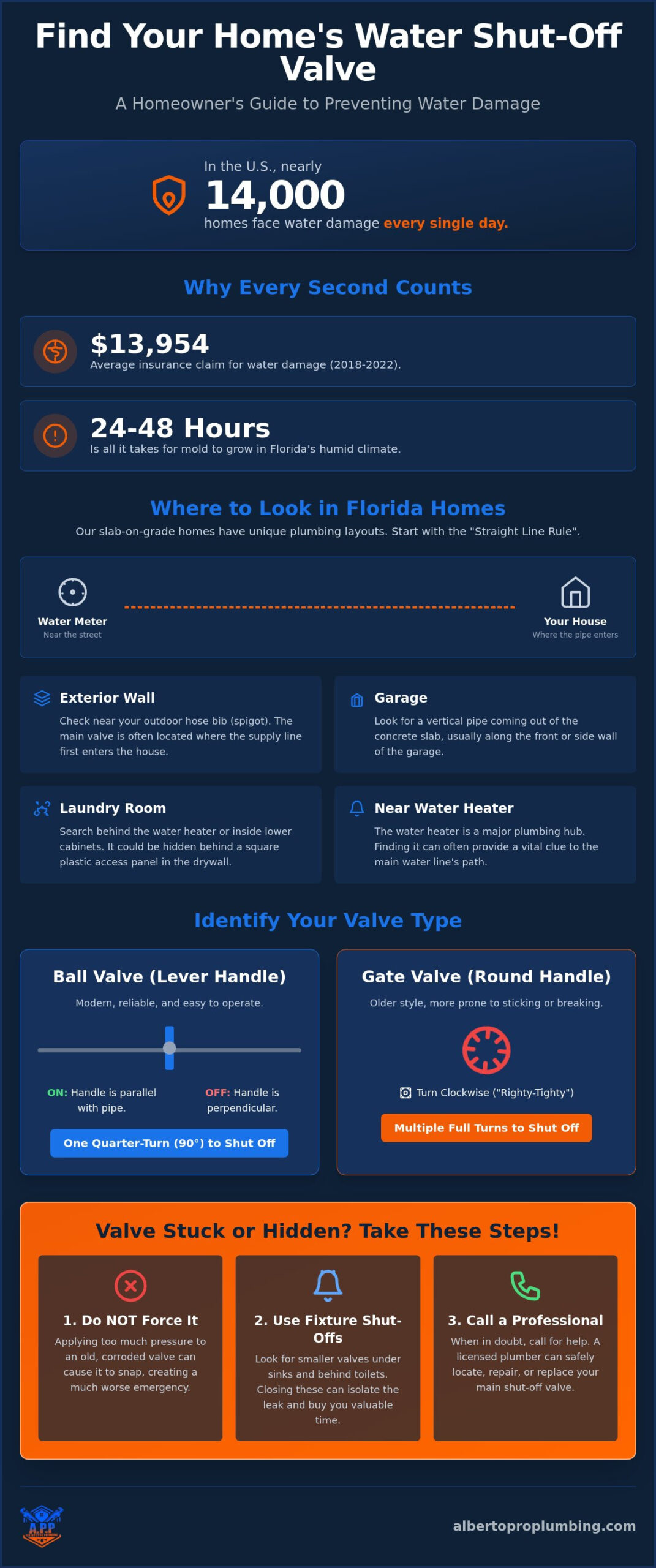
If you look at generic plumbing guides online, they often tell you to head to the basement or check the crawlspace. In Central Florida, that advice is useless. Our homes are built on concrete slabs, which means your plumbing follows a different set of rules. When learning how to find the main water shut off valve, the most reliable strategy is the “Straight Line” Rule. Locate your water meter near the street and imagine a direct line running to your house. The valve is almost always located where that line first meets your exterior wall or enters the foundation.
Interior Locations: Garage and Laundry Rooms
For many homeowners in Clermont and surrounding areas, the search ends in the garage. Look for a vertical pipe emerging from the concrete slab along the front or side wall. This pipe often features a lever or a round handle. If your home has a finished interior, check the laundry room. The valve might be tucked behind the water heater or hidden inside a lower cabinet. Some builders install plastic “access panels” in the drywall to maintain a clean look. If you see a square plastic plate on the wall, pop it open; the valve is likely sitting right behind it. If you’ve searched these spots and still can’t find it, a professional leak detection specialist can help trace your lines to the source.
Exterior Walls and Perimeter Checks
If the valve isn’t inside, it’s almost certainly on an exterior wall. Walk the perimeter of your home, specifically looking at the area closest to the street. Check near the outdoor spigot, also known as the hose bib. Often, the main shut-off is located just below or beside the faucet where the main line enters the structure. In some newer subdivisions, the valve is housed in a recessed plastic or metal box built into the siding, often near the front corner of the house. These boxes can sometimes be obscured by overgrown landscaping or mulch.
Don’t forget to check near your water treatment equipment. If you have a water softener or a whole-home filtration system, the main shut-off is usually located just before the water enters those units. Knowing how to find the main water shut off valve in these specific spots saves you from wandering aimlessly during a crisis. Once you find it, clear away any dirt or debris so it remains accessible. It’s a simple step that ensures you’re prepared for any future plumbing emergency.
Identifying Your Valve Type: Ball Valves vs. Gate Valves
Once you have mastered how to find the main water shut off valve, the next step is identifying which type of hardware you are dealing with. In Central Florida, the age of your home usually dictates the technology installed. Newer constructions almost exclusively use ball valves, while older properties often rely on gate valves. Understanding the difference is crucial because using the wrong technique can lead to a broken handle and an even bigger mess during a crisis. You need to know exactly how your specific “kill switch” operates before you are standing in an inch of water.
The two types look and act differently. A ball valve uses a lever handle, while a gate valve uses a round wheel. Regardless of the style, you should always operate these valves slowly. Sudden changes in water pressure can cause “water hammer,” which puts unnecessary stress on your joints and fixtures. If the valve hasn’t been touched in years, a gentle touch is your best defense against causing a secondary leak at the valve itself.
Operating a Ball Valve
Ball valves are the modern industry standard for a reason. They feature a heavy-duty lever handle that controls a polished metal ball inside the pipe. These are incredibly reliable and rarely seize up, even in our humid environment. To turn the water off, you simply rotate the lever 90 degrees. When the handle is parallel to the pipe, the water is flowing. When the handle is perpendicular, forming a “T” shape with the pipe, the water is completely shut off.
The “quarter-turn” advantage is a lifesaver in an emergency. You don’t have to spend a full minute spinning a wheel while your floors get soaked. A quick flick of the wrist stops the flow instantly. To keep a ball valve moving freely, try to turn it off and back on once a year. This simple maintenance prevents mineral deposits from locking the internal mechanism over time.
Troubleshooting a Gate Valve
If your home was built before the mid-1990s, you likely have a gate valve. These look like the round wheels you find on a garden hose spigot. Inside, a metal “gate” lowers or raises to block the water flow. Always remember the “clockwise” rule: turn the wheel to the right to close it. However, gate valves have a high failure rate in Florida due to our mineral-heavy water. Sediment builds up in the tracks at the bottom of the valve, which often prevents the gate from seating fully. This means the water might keep trickling even when the valve is supposedly closed.
If the handle feels stuck, never use a wrench or pliers to force it. The internal stem is often made of relatively soft brass and can snap easily under mechanical pressure. If it doesn’t move with firm hand pressure, it has likely seized. Forcing a stuck gate valve can leave you with a handle that spins freely while the water continues to gush, making a professional replacement your only option. Knowing how to find the main water shut off valve is only half the battle; knowing when to stop pulling is just as important.
The Step-by-Step Search Strategy (Inside and Outside)
Finding your shut-off valve shouldn’t feel like a high-stakes scavenger hunt. If you’ve already checked the most common garage and exterior wall locations mentioned earlier and still come up empty, it’s time for a methodical search. Most homeowners can master how to find the main water shut off valve by following the physical clues left behind by the original plumbers. Start by walking the front perimeter of your home closest to the street. Look for any pipe that enters the foundation or a small plastic box set into the ground near the house. If the path isn’t obvious, head to your water heater. The cold water supply line, usually the pipe on the right side of the tank, can be traced back through the walls or floor to find where it connects to the main exterior source.
Another reliable trick is to consult your home inspection report. If you purchased your home recently, the inspector likely photographed and labeled the main shut-off location under the “Plumbing” or “Utilities” section of the document. This is often the fastest way to solve the mystery without leaving your couch. If you still find yourself in a bind during a crisis, our team is ready to help with Emergency Plumbing services to protect your property from rising water.
Locating the Outdoor Meter Box
If you cannot find a dedicated shut-off valve on the house itself, your last resort is the water meter box. This is usually located at the property line near the sidewalk or street. Look for a rectangular concrete or plastic lid, often labeled “Water” or “City.” In Central Florida, these boxes are prime real estate for black widow spiders, fire ants, and even small snakes. Always use a long screwdriver or a specialized lid key to lift the cover rather than your bare hands. Inside, you will see the meter and a valve. You may need a “Curb Key” (a long, T-shaped metal tool) to turn this valve, as they are often buried deep and can be very stiff. Turning this valve clockwise will kill the water to the entire property, including your irrigation system.
Following Visible Water Lines
To distinguish your main line from other pipes, look for a 3/4-inch or 1-inch pipe made of copper or PEX (usually blue or white plastic). In many Clermont homes, the main line enters through the garage floor. Follow this pipe carefully; if it branches off into smaller 1/2-inch lines, you’ve moved past the main shut-off. It’s also important to distinguish the main house line from irrigation lines. Irrigation pipes often branch off near the meter and stay outside the home’s footprint. If you find a valve that only stops the sprinklers, keep following the larger pipe toward the house. Knowing how to find the main water shut off valve by tracing these lines ensures you aren’t turning off the wrong system while your kitchen is flooding.
What to Do if You Can’t Find or Turn the Valve
If you have followed every step in this guide and still can’t locate the handle, or if you’ve found it only to realize it’s frozen solid, take a deep breath. Panic leads to rushed decisions and broken pipes. If water is actively flooding your home and the main valve is nowhere to be found, start by shutting off the individual valves located directly under the affected sink or toilet. These small “angle stops” are your first line of defense. Turning them clockwise will stop the flow to that specific fixture and buy you time while you address the larger issue. If the leak is behind a wall or under the slab, move quickly to clear your belongings away from the water path.
For those who have successfully mastered how to find the main water shut off valve but find the handle won’t budge, the “Gentle Tap” method is a safe first step. Use the back of a screwdriver or a small wrench to lightly tap the valve body and handle. This vibration can sometimes break the mineral bonds or rust holding the internal components in place. If the handle remains stubborn, don’t force it with all your strength. Forcing a seized valve often results in a snapped stem, turning a stressful situation into a full-blown catastrophe. When the DIY methods fail, it’s time to call for emergency plumbing repair to prevent further damage to your foundation and flooring.
Dealing with Seized or Rusted Valves
Florida’s mineral-heavy water is notorious for causing scale buildup inside older plumbing hardware. If you’re dealing with a stuck gate valve, you can try applying a small amount of penetrating oil, such as WD-40, to the stem where it enters the valve body. Let the oil sit for at least ten minutes to work its way into the threads before trying to turn it again. Be careful not to get oil on any plastic PEX piping, as some chemicals can degrade the material over time. A seized main valve is not just a minor inconvenience; it’s a priority repair that should be addressed during your next plumbing service. Replacing a failing gate valve now ensures that the next time you need to know how to find the main water shut off valve, the system actually works.
Calling in the Pros: Alberto Pro Plumbing
At Alberto Pro Plumbing, we help Clermont residents navigate these stressful moments with precision and care. If your valve is hidden behind a finished wall or buried under years of mulch, our team uses specialized tools to locate the line without tearing up your property. We don’t just find the problem; we provide long-term solutions. We frequently upgrade old, unreliable gate valves to modern, stainless steel ball valves that offer a smooth quarter-turn operation. To ensure you’re never caught off guard again, consider our Home Protection Membership. This program includes annual inspections of your main shut-off and all fixture valves, giving you the peace of mind that your home’s “kill switch” is always ready for action. We take pride in leaving every workspace tidy and ensuring your family feels safe and respected throughout the repair process.
Protect Your Property with Proactive Plumbing Knowledge
Mastering how to find the main water shut off valve is one of the most impactful things you can do to safeguard your Central Florida home. By understanding the unique layout of our slab-on-grade houses and identifying whether you have a modern ball valve or an older gate valve, you have already taken a massive step toward preventing catastrophic water damage. Remember to test your valve at least once a year to ensure it hasn’t seized up from mineral deposits. This simple habit keeps your plumbing “kill switch” ready for action whenever you might need it.
Just as you maintain your plumbing’s “kill switch,” having the right training for other emergency scenarios is equally important; you can learn more about delrayfirearmstraining.com to see how their courses can further bolster your home’s safety strategy.
If your valve remains hidden or won’t budge despite your best efforts, don’t risk a broken pipe by forcing it. Can’t find your valve or dealing with a leak? Call Alberto Pro Plumbing for 24/7 Emergency Service! Our licensed and insured local experts provide rapid response across Central Florida to handle any crisis. We stand by our tidy service promise; we always leave your home exactly as we found it. You’ve done the hard work of educating yourself. Now, rest easy knowing you have the tools and the support to handle any plumbing emergency with confidence.
Frequently Asked Questions
Is the main water shut-off always near the water heater?
No, the main shut-off is not always located near the water heater. While many Florida builders place them in the same utility closet or garage area, the valve on your water heater usually only controls the cold water entering that specific tank. To stop the flow to your entire home, you need to find the primary valve where the main line enters your foundation or exterior wall.
Can I turn off my water at the street without a special tool?
It is very difficult to turn off the water at the street without a “Curb Key.” Most municipal water meters are housed in deep concrete boxes, and the valve itself features a rectangular metal tab that is hard to grip with standard pliers. While you can buy these tools at local hardware stores, it is much safer and faster to have a working shut-off valve located on your actual house.
Which way do I turn the main water valve to shut it off?
You turn the valve clockwise to shut the water off. If you have a modern ball valve, rotate the lever 90 degrees until it is perpendicular to the pipe. For older gate valves with round handles, follow the “righty-tighty” rule and spin the wheel to the right until it stops. Always turn the handle slowly to avoid a sudden pressure spike in your plumbing system.
What happens if I break the handle off my water shut-off valve?
If the handle snaps off, you must call a professional plumber immediately to replace the entire valve. Do not attempt to turn the remaining metal stem with pliers, as this often causes the internal seals to fail and results in a secondary leak. A broken valve means you have no way to protect your home during a crisis, making this a high-priority repair.
Why is my water still running after I turned the main valve off?
Water often continues to run for a minute or two because of the residual pressure trapped in your pipes. To clear the lines, open the lowest faucet on your property, such as an outdoor hose bib. If the water continues to flow with full pressure after several minutes, your main valve has likely failed internally and is no longer creating a complete seal.
How often should I test my main water shut-off valve?
You should test your valve at least twice a year to ensure it remains functional. Simply turning the handle off and back on again prevents mineral scale from locking the internal components. Regular maintenance ensures that when you’re frantically searching how to find the main water shut off valve during a burst pipe, the hardware actually works when you need it most.
Does a tankless water heater have its own main shut-off?
Tankless water heaters feature their own dedicated service valves located directly beneath the unit, but these are not house-wide shut-offs. These valves allow you to isolate the heater for descaling or repairs without turning off the water to your toilets or kitchen. You still need to locate the primary house valve to stop the flow to the rest of your plumbing fixtures.
Should I turn off the water heater power after shutting off the water?
Yes, you should always turn off the power or gas to your water heater if you are shutting off the main water for more than a few minutes. If the water level in a standard tank drops while the heating elements are still active, the elements can burn out or damage the tank lining. For electric models, simply flip the labeled breaker in your main electrical panel to stay safe.