
What if a damp patch on your wall is a clue, not the leak’s location? Water can travel from its source before it becomes visible, so cutting into a wall or floor right away may cause unnecessary disruption. Professional non-invasive leak detection methods help narrow down where a leak may be hiding before repair begins.
It’s understandable to want a clear answer without turning your home into a guessing game. The right method depends on the signs of a leak and what needs to be investigated. Acoustic tools listen for leak sounds, thermal cameras reveal temperature patterns, and tracer gas can help track a leak’s path. Each method provides different clues, and detection can guide a repair decision without guaranteeing that no access will be needed.
This guide explains what common methods measure, how to compare their findings, and what details to share when arranging professional leak detection. Alberto Pro Plumbing provides Leak Detection & Repiping in Clermont, Florida and serves Lake County, Polk County, Osceola County, and Orange County. Its plumbers are licensed and insured.
Key Takeaways
- Non-invasive leak detection methods help narrow down a likely leak source while limiting exploratory opening, but results depend on the clues available.
- Compare methods by the signal they detect and the situation they suit, rather than assuming one approach works best for every leak.
- Before the visit, note when the concern began and where you’ve seen moisture or other changes to help guide the investigation.
- Detection findings can inform the repair plan, though some leaks may still require access to the affected area.
- Alberto Pro Plumbing provides Leak Detection & Repiping with licensed and insured plumbers serving Clermont, Florida and surrounding service areas.
What Are Non-Invasive Leak Detection Methods, and What Can They Find?
A wet patch shows that water is present, but it may not reveal where the water entered the building. It can travel along a pipe, framing, or another surface before becoming visible, which means the damp area and the leak source may be some distance apart. Investigating the evidence is more useful than opening the nearest wall or floor based on appearance alone.
Non-invasive leak detection methods are diagnostic approaches that help locate and assess a suspected leak while limiting exploratory opening. A plumber looks for clues that can narrow down a likely source, such as sound, temperature differences, or moisture patterns. Building materials, pipe routes, and the leak itself affect what those clues reveal, so no single reading guarantees a precise result in every property.
For a general overview of how professionals investigate leaks in different settings, see Leak detection methods. In a home, the goal is to consider the clues that fit the reported problem. Several observations may need to be compared, especially if water has moved from its original point of escape.
What does non-invasive mean in plumbing leak detection?
It means investigating before cutting into a wall, lifting flooring, or breaking into concrete to expose a pipe. The plumber assesses the reported problem and available evidence, then uses an appropriate diagnostic approach to narrow the area of concern. This can help avoid opening an unnecessarily large or incorrect section of a surface.
Non-invasive doesn’t mean there will never be disruption. If the findings point to a specific location, a plumber may recommend targeted access to inspect or repair the pipe. Detection informs that decision, but it doesn’t replace the repair itself. Locating the likely source and fixing the damaged plumbing are separate steps in resolving a leak, while handling structural drying and recovery often calls for specialists like DK Production Restoration.
What kinds of hidden leaks may prompt a professional investigation?
A suspected leak may be inside a wall, beneath a floor, or along a concealed pipe route, including plumbing under a concrete slab. Visible dampness is useful evidence, but it doesn’t prove that the pipe directly behind that spot is leaking. Water may follow a surface or structural path before appearing, so the location needs to be assessed in context.
For example, moisture near a wall-floor junction might suggest a nearby pipe, while the source could be elsewhere along the route. A plumber can compare the visible evidence with other diagnostic clues to narrow down the likely area. That supports a better-informed repair decision, but it doesn’t guarantee every leak can be found without access or that diagnosis alone will stop the water. In cases where moisture intrusion stems from structural seepage rather than supply pipes, leak repair contractors such as waffen.com.sg can assist in diagnosing and sealing building entry points.
How Non-Invasive Leak Detection Methods Work
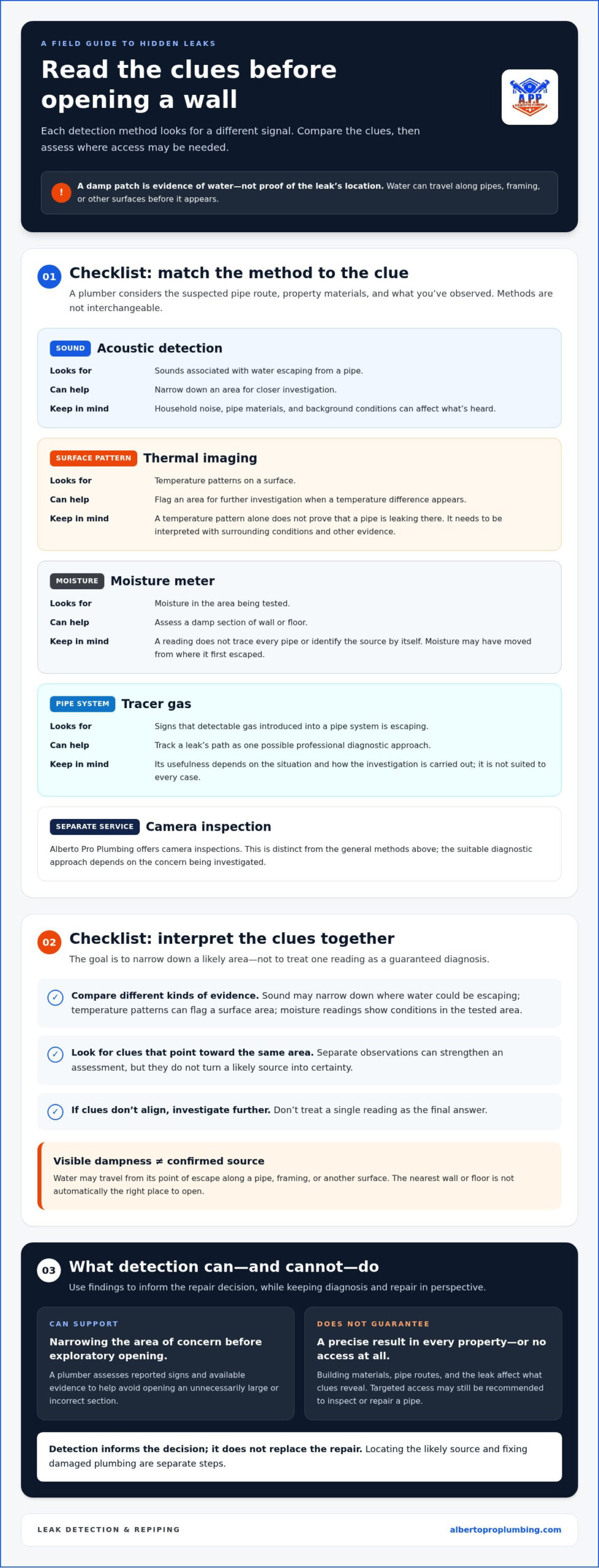
Each diagnostic approach looks for a different kind of evidence. One may pick up sound associated with escaping water, while another reveals surface temperature patterns or measures moisture in a specific area. These non-invasive leak detection methods aren’t interchangeable tools with identical results. A plumber considers the suspected pipe route, property materials, and reported observations to decide which clues may be useful.
How do acoustic and thermal methods help locate a leak?
Acoustic detection involves listening for sounds associated with water escaping from a pipe. The sound may help narrow down an area for closer investigation, but household noise, pipe materials, and other background conditions can affect what’s heard.
Thermal imaging shows temperature patterns on a surface. A temperature difference may point to an area for further investigation, but it doesn’t prove on its own that a pipe is leaking there. A professional interprets the pattern alongside surrounding conditions and other available evidence.
What can moisture meters, tracer gas, and camera inspections reveal?
A moisture meter measures moisture in the area being tested. The reading can help assess a damp section of wall or floor, but it doesn’t trace every pipe or identify the leak source by itself. Moisture may also have moved from where it first escaped.
Tracer gas is another method used in professional leak detection. In general, it involves introducing a detectable gas into a pipe system and checking for signs of escape. Its usefulness depends on the situation and how the investigation is carried out. It is one possible diagnostic approach, not a tool suited to every case.
Why interpret clues together?
When separate clues point toward the same area, they can strengthen a plumber’s assessment, but they don’t turn a likely source into a guaranteed diagnosis. For instance, a moisture reading may show where dampness is present, while another observation helps assess whether a nearby pipe could be involved. If the clues don’t align, further investigation may be needed instead of treating one reading as a final answer.
- Sound can help narrow down where water may be escaping.
- Temperature patterns can flag a surface area for closer inspection.
- Moisture readings show conditions in a tested area, not the route of every pipe.
Alberto Pro Plumbing offers camera inspections as a plumbing service. A camera inspection is distinct from the general methods described above, and the right diagnostic approach depends on the concern being investigated. When arranging professional leak detection, share what you’ve observed to help the plumber assess the problem and plan a suitable next step.
Which Leak Detection Method Fits the Suspected Leak?
No single detection method suits every suspected leak. The likely pipe location, the surface covering it, and the evidence already available all shape the investigation. A wall cavity, a finished floor, and a pipe beneath concrete present different conditions. Professionals consider what each method can reveal and where its limits lie. The aim is to select useful diagnostic clues, not to declare one tool the winner in every home.
| Method | Signal detected | Useful context | Limitation |
|---|---|---|---|
| Acoustic detection | Sound associated with water escaping from a pipe | Can help narrow a search near a suspected pipe route behind a wall or below a floor. | Background noise and building materials can affect how clearly the sound can be interpreted. |
| Thermal imaging | Temperature patterns across a surface | May highlight an area for further investigation when the surface shows a temperature difference. | A temperature pattern is a clue, not proof of a leak or an exact pipe defect. |
| Moisture meter | Moisture level in the area being tested | Can help assess a damp patch on an accessible wall or floor surface. | Measures the tested area; it doesn’t map the full pipe route or establish where water began. |
| Tracer gas | Detectable gas escaping from a pipe system | May be considered when other clues leave the suspected source uncertain. | Its suitability depends on the system and conditions, and it won’t be the right approach for every leak. |
These options provide different kinds of evidence rather than competing answers. A method that helps in one part of a home may offer less information in another. Surface materials, access to the suspected pipe route, and the pattern of moisture all matter. The comparison shows the kind of clue each approach can provide, not a guaranteed result.
How do methods differ for leaks behind walls and under floors?
Behind a wall, sound-based clues may help narrow the search along a concealed pipe route. A thermal pattern or moisture reading can point to a surface area that deserves attention, but neither necessarily identifies the exact pipe or defect behind it. Beneath a floor, the same principle applies: a clue can guide further investigation, but no method guarantees a precise location beneath concrete in every property.
When might professionals combine more than one detection clue?
Combining observations can help when one signal leaves several possible explanations. For example, a damp area can show where moisture is present, while another clue helps assess whether a concealed pipe could be involved. If separate findings converge, they can help focus any later repair access. If they don’t align, more investigation may be needed before deciding where to open a surface.
The practical question isn’t simply which tool sounds most advanced. It’s which evidence best fits the suspected leak and the conditions in that home. A plumber can weigh those factors and explain how the findings inform the next repair decision.
How to Prepare for a Non-Invasive Leak Detection Visit
A few clear notes can help a plumber understand what you’ve noticed and where to begin. You don’t need to identify the cause or choose among non-invasive leak detection methods yourself. Focus on what you observed, when it happened, and any plumbing history that may provide useful context.
What information should you share before the inspection?
Before the visit, make a simple timeline and note where you’ve seen moisture or other changes. If the issue comes and goes, mention that. Photos can show how an area looked when you first noticed it, especially if its appearance has changed.
- Record when it began. Note the first day you noticed the concern and whether it has become more or less noticeable since then.
- Mark where you observed it. Describe the room and surface, such as a wall near a bathroom or flooring beside a kitchen fixture. Stick to what you observed rather than assuming the pipe behind it is leaking.
- Share relevant plumbing history. Mention previous pipe repairs or recurring problems in the same area. If you have accessible information about the property’s plumbing or layout, have it ready.
- Explain access details. Point out areas that may be difficult to reach, along with rooms or surfaces connected to the concern. This helps the plumber understand the property before assessing the evidence.
Keep your notes brief. For example: “I noticed a damp mark on the hallway wall last week; it looked larger yesterday, and there was a pipe repair in the adjacent bathroom.” That gives the plumber a location, timeline, and relevant history without trying to diagnose the source.
What should you expect from a professional assessment?
A plumber assesses the reported concern and available clues, then considers what further investigation may clarify the likely source. The method depends on the situation, so there isn’t one fixed approach or guaranteed outcome for every property.
Share what you know and let the evidence guide the discussion. Findings can help explain whether targeted access may be needed and inform a suitable repair approach. Detection and repair are separate steps, so ask the plumber to explain what the assessment indicates and what work may follow.
Alberto Pro Plumbing provides Leak Detection & Repiping, and its plumbers are licensed and insured. To arrange professional leak detection and discuss what you’ve observed, contact Alberto Pro Plumbing.
Professional Leak Detection in Central Florida: Your Next Step
Unclear leak clues don’t have to leave you guessing about what to do next. Alberto Pro Plumbing provides Leak Detection & Repiping for homeowners in Clermont, Florida and across its service area. A professional assessment can inform a repair decision, while the findings and property conditions determine whether access will be needed. No detection approach can promise that every investigation will avoid disruption.
What can Alberto Pro Plumbing help with?
Alberto Pro Plumbing provides leak detection, repiping, and leak and pipe repairs. Its plumbers are licensed and insured, and the company also offers camera inspections. The right next step depends on the concern and what the investigation reveals, whether that means discussing a repair or considering broader pipe work.
Clear information matters throughout the process. Alberto Pro Plumbing provides transparent, honest pricing with no hidden fees, so you can discuss the work before moving forward. Share what you’ve observed and any relevant repair history to help the plumber understand the concern and explain the findings in practical terms.
How do you request leak detection service?
Alberto Pro Plumbing serves homeowners in Lake County, Polk County, Osceola County, and Orange County, including Clermont, Florida. Before reaching out, gather a short description of where you noticed the concern and when it began. If you’ve seen moisture appear in more than one area or change over time, include that detail. These observations help start a focused conversation without asking you to diagnose the pipe yourself.
After the assessment, the findings can guide a discussion about suitable repairs. If the issue points to a damaged pipe, leak and pipe repairs may be the next consideration. If recurring problems raise questions about a wider pipe system, repiping is also part of the company’s plumbing services. The investigation helps establish the concern; the repair addresses it.
If a hidden leak has you concerned, take the next step with a local plumbing team. Request a quote for leak detection from Alberto Pro Plumbing through the company website or call 407-764-7090. Have your notes about the location, timing, and any previous plumbing repairs ready so you can explain what’s happening clearly.
Let Clear Evidence Guide Your Next Step
A hidden leak can make every mark on a wall or floor feel like a guess. You don’t have to solve the mystery alone. Think of non-invasive leak detection methods as a way to replace assumptions with evidence that can guide your next decision. The goal isn’t to chase a perfect tool or force a diagnosis from one clue. It’s to understand what the findings suggest and what they mean for your home.
As you move forward, keep your observations handy and stay open to a focused investigation. A clear conversation about the concern gives your plumber a practical place to begin. The findings can then shape a repair discussion around the specific issue, rather than guesswork or unnecessary assumptions.
For a professional next step, request leak detection service from Alberto Pro Plumbing. A clearer understanding of the problem can make it easier to decide what comes next. You’re not left to figure it out on your own.
Frequently Asked Questions
Can non-invasive leak detection find a leak behind a wall?
Yes, non-invasive leak detection methods can help narrow down a suspected leak behind a wall without immediately opening the surface. The result depends on the pipe, wall materials, and available clues, so it may identify a likely area rather than the exact defect. For example, if a damp patch is near a bathroom, tell the plumber which fixtures are on the other side of the wall. That context can help focus the investigation.
Is non-invasive leak detection always completely damage-free?
No. The diagnostic assessment may limit exploratory opening, but it can’t guarantee that no surface will need to be opened. If findings point to a particular section of pipe, targeted access may be needed to confirm the condition or complete a repair. Ask the plumber to explain what the evidence suggests and why access may be appropriate before work begins. Detection helps guide the plan, but it doesn’t repair the pipe.
How accurate are non-invasive leak detection methods?
Accuracy varies with the leak, pipe location, building materials, and conditions during testing. A result may point to a likely area without showing the exact size or cause of the pipe damage. For instance, a moisture reading can confirm dampness at the tested spot, but that alone doesn’t prove the leak originates there. Treat findings as evidence for a professional assessment, not as a guarantee of a precise result in every property.
Can a plumber detect a leak under a concrete floor without breaking it?
A plumber may be able to investigate a suspected leak beneath concrete without breaking the floor during the initial assessment. However, no method guarantees an exact location in every case, and access may still be needed to verify or repair the pipe. Share where the concern appears and whether plumbing runs nearby, such as a bathroom or kitchen supply line. That background helps frame the investigation without assuming the floor must be opened.
Do plumbers use thermal imaging to find water leaks?
Some plumbers use thermal imaging to inspect temperature patterns on a surface and identify areas for further investigation. A camera’s image is a clue, not proof of a leak: temperature differences can have other explanations, and wall or floor materials affect what appears. A plumber interprets the pattern in context and may compare it with other evidence. Thermal imaging isn’t the right answer for every suspected leak.
What happens if non-invasive testing does not locate the leak?
If testing doesn’t identify a likely source, the next step is to review the evidence and decide whether further investigation is useful. The plumber may reconsider the suspected pipe route, account for conditions that affected the readings, or discuss whether targeted access is needed. An uncertain result shouldn’t be presented as a confirmed diagnosis. Ask what the testing established, what remains unknown, and how that affects the repair plan.
Should I arrange professional leak detection if I cannot see the source?
Yes, professional leak detection can help investigate a plumbing concern when visible signs don’t reveal the source. Note where and when you first observed a change, even if there’s no obvious wet patch now. In Clermont, Florida, Alberto Pro Plumbing provides Leak Detection & Repiping, and its plumbers are licensed and insured. Share your observations when requesting service to give the plumber a useful starting point for assessing the concern.