
You step into the shower after a long day in the Florida sun, only to be met with a pathetic drizzle that barely rinses the soap away. It’s frustrating when your dishwasher takes twice as long to run and your morning routine feels like a constant battle against your own plumbing. Dealing with low water pressure in house systems is a common headache for our neighbors here in Central Florida, especially in areas with older infrastructure or high mineral content in the water. You might worry that a hidden slab leak is silently damaging your foundation or that your pipes are simply reaching the end of their functional lifespan.
We believe you shouldn’t have to guess whether a repair is a simple weekend project or a major emergency. This guide will help you identify the root cause of your weak flow, from common limescale buildup caused by Orlando’s hard water to failing pressure regulators. You’ll learn how to rule out city-wide issues and understand the clear signs that it’s time to call in a professional. Let’s get your water flowing at full strength again so you can get back to enjoying your home with total peace of mind.
Key Takeaways
- Isolate the issue by checking individual fixtures and talking to neighbors to see if the drop is a local utility problem or unique to your home.
- Identify signs of a failing Pressure Reducing Valve (PRV), which often causes sudden low water pressure in house plumbing across Central Florida.
- Learn how the Floridan Aquifer’s hard water creates limescale buildup that restricts flow in older galvanized steel pipes.
- Perform a simple meter test to rule out hidden leaks and protect your property from potential water damage.
- Understand when professional diagnostics like camera inspections or hydro-jetting are necessary to clear stubborn mineral blockages.
Troubleshooting Sudden Low Water Pressure: First Steps for Homeowners
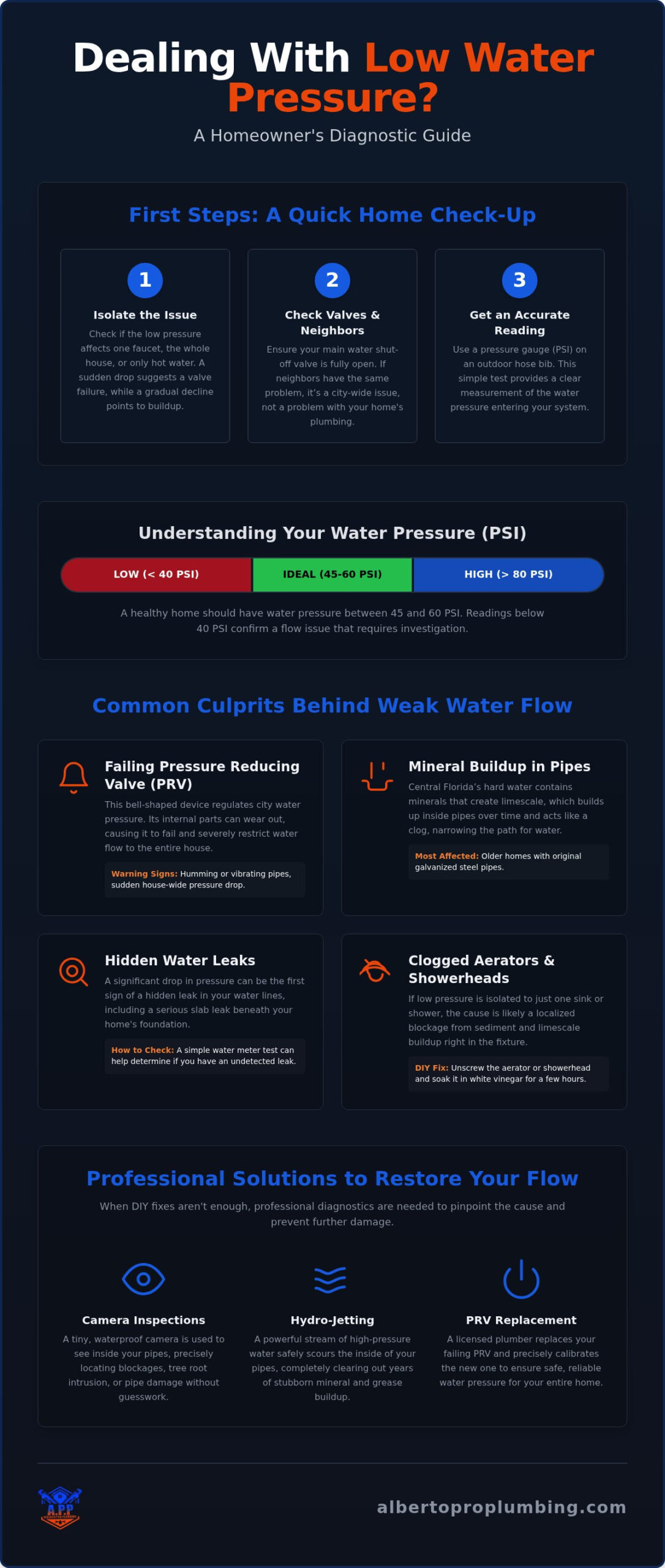
When you notice low water pressure in house pipes, your first instinct might be to panic about a major repair bill. Take a breath. Many pressure issues are actually quite simple to diagnose. Before you call for help, you can perform a few quick checks to narrow down the source of the problem. Start by determining if the issue affects your entire property or just one specific area. This simple distinction helps you decide if you’re dealing with a minor fixture clog or a systemic failure in your plumbing system.
Is the Problem Global or Local?
Test multiple faucets throughout your home to see if the drop in flow is consistent. If the kitchen sink is barely a trickle but the master shower is blasting normally, you likely have a localized clog in a single aerator or showerhead. You should also check both hot and cold water separately. If the pressure drop only happens when you use hot water, the issue is almost certainly tied to your water heater rather than your overall supply lines. Think about the timing too. Did this happen suddenly this morning, or has the flow been getting weaker for months? A sudden drop often points to a mechanical valve failure or municipal issue, while a gradual decline usually suggests mineral buildup common in Central Florida.
Checking Your Main Water Valves
Don’t overlook the simplest solution. Walk out to your main shut-off valve, which is typically found near the front of your house or by the water meter at the street. Ensure the handle is turned completely to the open position. It sounds basic, but a partially closed valve is the #1 “free fix” for low pressure. Sometimes, utility workers or even contractors working nearby can accidentally nudge these valves. While you’re outside, check with your neighbors. If everyone on the block is experiencing the same weak flow, the problem is likely a water main break or city maintenance. In those cases, you simply have to wait for the utility company to finish their repairs.
If your valves are open and the neighbors are fine, consider testing your pressure with a simple PSI gauge from a local hardware store. You can screw this onto an outdoor hose bib to get an accurate reading. A healthy reading for a home should stay between 45 and 60 PSI. If your gauge shows anything below 40 PSI, you’ve confirmed a genuine pressure issue that requires a closer look at your home’s internal components.
Mechanical Failures: Pressure Regulators and Faulty Fixtures
If your neighbors have great flow but you’re struggling with low water pressure in house systems, the culprit is often a mechanical failure right on your property. While pipes get most of the attention, the valves and fixtures that control your water are complex moving parts. These components are under constant stress from the pressure of the municipal supply and the unique chemistry of our local environment. The Hardness of ground water in our region means that minerals are constantly working against these moving parts, leading to premature wear and unexpected clogs.
The Pressure Reducing Valve (PRV)
Most modern homes in Central Florida feature a Pressure Reducing Valve, which is a bell-shaped brass device usually located near your main water shut-off. Its job is to take the high-pressure water from the city main and throttle it down to a safe level for your indoor pipes. Inside this valve is a rubber diaphragm and a spring. Over time, the diaphragm can rupture or the spring can lose its tension, causing the valve to “fail closed” and severely restrict your flow. You might notice vibrating pipes or hear a strange humming sound coming from the walls when you turn on a faucet; these are classic warning signs that your regulator is failing. Because the PRV requires precise calibration to prevent your pipes from bursting under too much pressure, replacing one is a task best left to a professional who can set the PSI to the ideal range for your specific home.
Fixture-Specific Pressure Drops
Sometimes the problem isn’t your whole house, but rather the individual fixtures you use every day. If you notice the pressure is only weak at the kitchen sink or a specific shower, you likely have a localized blockage. Small screens called aerators sit at the tip of your faucets to steady the flow, but they easily trap sediment and limescale. You can often fix this yourself by unscrewing the aerator and soaking it in white vinegar for a few hours to dissolve the buildup.
- Check for “water-saving” restrictors inside new showerheads that may be clogged with construction debris.
- Look for leaking handles, which often indicate an internal cartridge failure that mimics low pressure.
- Clean mineral deposits from showerhead nozzles using a small brush or a vinegar-filled baggie tied around the fixture.
If cleaning the aerator doesn’t solve the problem, the internal cartridge inside the faucet handle might be worn out or blocked. If you suspect your regulator has reached its limit or your fixtures are beyond a simple cleaning, a professional fixture installation or PRV replacement can restore your home’s comfort and flow in a single visit.
The Central Florida Factor: Hard Water, Limescale, and Aging Pipes
Central Florida sits on a massive limestone shelf known as the Floridan Aquifer. While this provides us with a reliable water source, it also means our supply is packed with dissolved minerals. This “hard water” is the primary reason many local residents experience low water pressure in house systems over time. As water travels through your lines, calcium and magnesium slowly solidify into a rock-hard crust known as limescale. This isn’t just a cosmetic issue on your faucets; it happens deep inside your plumbing where you can’t see it.
Mineral Buildup and Pipe Constriction
Think of limescale like “clogged arteries” for your plumbing. In Clermont and surrounding areas, Orlando’s water often measures between 129 and 190 ppm (parts per million), which classifies it as very hard. These minerals love to settle in your water heater. When hard water is heated, the minerals separate and sink to the bottom of the tank, creating a thick layer of sediment. This “sludge” acts as a physical barrier that restricts water flow out of the tank and forces your heater to work much harder. Regularly flushing your water heater is a critical maintenance step to prevent this sediment from choking off your hot water pressure.
For neighbors on rural properties in Lake or Polk counties, well water brings its own set of challenges. Fine sand and organic sediment can bypass older filtration systems. This grit eventually settles in the low points of your plumbing or clogs the intake screens of expensive appliances, leading to a frustrating drop in performance.
Galvanized vs. Copper vs. Polybutylene
The age of your home often dictates the type of pipes hidden behind your walls. If you live in an older Lake County home built before the 1960s, you might still have galvanized steel pipes. These pipes are notorious for rusting from the inside out. This internal corrosion is often invisible from the exterior, but it creates a rough, narrowed passage that catches minerals and eventually chokes off the water supply. Even copper pipes can suffer from “pitting” corrosion, where tiny pinholes develop and cause pressure loss before a major leak becomes obvious.
Many Florida homes built between 1978 and 1995 used polybutylene piping. These gray plastic pipes are extremely common in our region but are known to become brittle and fail due to the disinfectants in the municipal water supply. If your home relies on these legacy materials, a whole home repiping is often the most reliable way to restore your flow and protect your property from sudden water damage.
Hidden Dangers: When Low Pressure Signals a Major Plumbing Leak
While mineral buildup causes a slow and steady decline, a sudden drop in low water pressure in house lines often points to a rupture. If you’re losing pressure and seeing your water bill climb, you aren’t just dealing with a simple clog. You have a leak that is actively costing you money and potentially damaging your home’s structure. Unlike a dripping faucet, these leaks often happen in places you can’t see, making them difficult to catch until the damage is significant.
Performing a DIY Leak Check
A slab leak is a common but serious Central Florida plumbing issue where water lines fail beneath your home’s concrete foundation. Because our local soil is often sandy and prone to shifting, these underground pipes can experience stress that leads to cracks or pinholes. You might notice a sudden drop in pressure accompanied by a specific area of your floor that feels unusually warm to the touch. This often happens when a hot water line under the slab begins to leak, radiating heat through the tile or laminate above it.
You can confirm your suspicions with a simple meter test. First, ensure every faucet, shower, and appliance in your home is turned off. Locate your water meter, which is usually in a box near the street. Look at the small dial or leak indicator on the meter face. If it’s spinning while no water is being used, you have a leak. To be certain, write down the current reading and wait exactly 20 minutes without using any water. If the numbers have changed when you return, water is escaping your system somewhere between the meter and your fixtures. Check your yard for unusually lush green patches or soggy spots that never seem to dry out, as these are telltale signs of a buried line failure.
When to Call for Emergency Detection
Ignoring a hidden leak is a recipe for disaster. Constant water flow under your foundation can wash away the supporting soil, leading to foundation cracks that cost thousands to repair. It can also cause wood rot in your wall studs or provide the perfect environment for mold to thrive. Professional tools like thermal imaging and acoustic sensors can pinpoint the exact location of a break without tearing up your entire floor.
If your pressure vanishes overnight or your water bill doubles without explanation, don’t wait for the floor to buckle. Expert leak detection identifies the exact break point, saving you from unnecessary demolition and high utility costs. Treat sudden, severe pressure drops as an emergency plumbing repair to protect your property and restore your home’s water flow immediately.
Restoring Your Flow: Professional Diagnostics and Long-Term Solutions
If you’ve gone through the basic checks and still face low water pressure in house lines, it’s time to bring in professional equipment. While a PSI gauge tells you that pressure is low, it doesn’t tell you why. Professional diagnostics take the guesswork out of the equation. We move beyond surface-level symptoms to find the actual physical cause of the restriction. Whether it’s a mechanical failure or a geological one, we have the tools to see what’s happening behind your walls and under your floors.
Professional Diagnostic Tools
We use electronic leak detection to find precise failure points in underground pipes without digging up your entire yard. This technology listens for the specific frequency of escaping water, allowing us to be surgical with our repairs. For internal issues, video camera inspections provide a live look inside your lines. This is the best way to identify if Central Florida’s hard water has created a “choke point” of mineral scale or if invasive tree roots have breached your main supply line. Once the lines are clear, we calibrate your Pressure Reducing Valve (PRV) to the optimal 50-60 PSI range. This ensures your home is both comfortable and safe from high-pressure bursts.
Sometimes, even a perfectly healthy system struggles because of regional utility limitations. If you live on a hill or at the end of a municipal line, a pressure booster pump can provide that extra power needed for a great shower. These pumps act as a local reservoir that kicks in when demand is high, ensuring your appliances run efficiently regardless of city-wide fluctuations. We also utilize hydro-jetting for lines that aren’t quite ready for a full repipe. This high-pressure water stream scours the inside of your pipes, blasting away the rock-hard limescale that we mentioned in previous sections.
Proactive Maintenance with Alberto Pro
The best way to handle pressure drops is to prevent them entirely. Regular maintenance removes the calcium and magnesium deposits before they can solidify into a major problem. Annual drain cleaning using hydro-jetting technology keeps your system running like new and protects your fixtures from unnecessary wear. It’s a proactive approach that saves you from the stress of a sudden morning shower turning into a trickle.
To stay ahead of these issues, we invite you to Join our Home Protection Membership. This program provides year-round peace of mind through proactive inspections. We catch small leaks, failing regulators, and mineral buildup before they turn into household emergencies. We take immense pride in our tidy service, ensuring your home is left exactly as we found it, just with better water flow. Don’t let plumbing anxiety ruin your day; let your local neighbors at Alberto Pro Plumbing handle the hard work for you.
Take Back Your Morning Routine
Dealing with weak flow doesn’t have to be a guessing game. By now, you know how to differentiate between a simple fixture clog and a more serious mechanical failure like a ruptured PRV diaphragm. You also understand how our regional hard water contributes to gradual limescale buildup that can eventually choke your pipes. Addressing low water pressure in house plumbing early is the best way to avoid the high costs associated with hidden leaks and foundation damage.
Our team of licensed and insured local experts understands Central Florida’s unique plumbing challenges better than anyone. We provide 24/7 emergency response for Lake County neighbors and stand by our tidy service guarantee; we’ll leave your workspace spotless every time. You deserve a shower that actually works and appliances that run at peak efficiency. Schedule a Professional Water Pressure Diagnostic today to restore your home’s comfort. We are here to help you get your water flowing at full strength again.
Frequently Asked Questions
Is low water pressure a plumbing emergency?
Low water pressure becomes an emergency if it happens suddenly across the entire house or is accompanied by signs of a major leak. If you see water pooling in your yard or hear water running when all faucets are off, you likely have a burst pipe or slab leak. These situations require immediate attention to prevent foundation damage. However, a gradual decline is usually a maintenance issue.
How do I know if my water pressure regulator is bad?
You can tell your regulator is failing if you notice sudden, dramatic spikes or drops in your home’s water flow. A faulty Pressure Reducing Valve (PRV) often produces a vibrating or humming sound in your walls when you turn on a faucet. If you use a PSI gauge and see readings that fluctuate wildly or stay well below 40 PSI, it’s time for a professional replacement.
Can a clogged drain cause low water pressure?
No, a clogged drain will not cause low water pressure in house systems. Drains are part of the wastewater system that carries water away from your home, while water pressure is determined by the supply lines bringing water in. If you have both slow drains and low pressure, you’re likely dealing with two separate issues; such as mineral buildup in the supply lines and a localized blockage in the sewer pipe.
Why is my water pressure low in only one room?
Pressure issues isolated to one room usually indicate a problem with a specific fixture or its dedicated shut-off valve. Mineral deposits often clog aerators in kitchen sinks or showerheads in the bathroom. If cleaning the aerator doesn’t help, the internal cartridge inside the faucet handle may have failed. Another possibility is that the local shut-off valve under the sink or behind the toilet isn’t fully open.
Will a new water heater increase my water pressure?
A new water heater can improve your hot water pressure if your old unit was heavily restricted by sediment and limescale buildup. In Central Florida, calcium deposits often settle at the bottom of the tank, creating a barrier that chokes off the flow. While a new heater restores that path, it won’t fix pressure issues affecting your cold water lines or problems from the main supply.
What is the normal water pressure for a house in Florida?
Standard residential water pressure in Florida typically ranges between 45 and 60 PSI. While the Florida Building Code requires a minimum residual pressure of 15 PSI at all fixtures, most homeowners find anything below 40 PSI to be unsatisfactorily weak. If your pressure exceeds 80 PSI, it can actually damage your pipes and appliances, making a properly calibrated regulator essential for your home’s safety and longevity.
Can hard water buildup be removed from pipes?
Yes, professional hydro-jetting can often remove significant mineral buildup from inside your plumbing. This process uses high-pressure water to scour the interior walls of your pipes, blasting away the rock-hard limescale common in our region. However, if you have older galvanized steel pipes that have corroded internally, cleaning may not be enough. In those cases, a whole-home repipe is often the only permanent solution to restore your flow.
Does a dirty water filter cause low water pressure?
A dirty or expired water filter is one of the most common causes of low water pressure in house systems. As the filter media traps sediment and minerals, it eventually becomes saturated and acts like a physical plug in your supply line. If you haven’t changed your whole-house filter or point-of-use cartridges in the last six months, replacing them is often the fastest way to restore your pressure.