
Could a single afternoon of foul odors or a slow drain actually cost your Clermont restaurant thousands in state-level fines and lost revenue? Running a commercial kitchen in Lake County is demanding enough without worrying about what’s happening beneath the floorboards. You’ve likely felt that spike of anxiety when a sink gurgles during a busy lunch rush or wondered if your records would truly pass a surprise inspection. It’s a common stressor for any local owner, but keeping up with professional commercial drain cleaning Clermont FL doesn’t have to be a headache.
This 2026 guide ensures your business stays compliant with Florida’s strict grease waste mandates while maintaining a kitchen that smells as fresh as your ingredients. We’ll walk you through the 25% FOG threshold rules and the mandatory 48-hour reporting window for all pump-outs. You’ll learn how to avoid $75 re-inspection fees and protect your bottom line from the tiered penalty structures established under Chapter 62-705 F.A.C. From manifest tracking to preventing emergency backups, let’s look at how proactive maintenance keeps your doors open and your drains clear.
Key Takeaways
- Understand why simple skimming isn’t enough and how a full pump-out protects your kitchen from foul odors and unexpected backups.
- Learn the “25% Rule” and how to set a maintenance schedule that keeps your business in line with Clermont’s strict FOG regulations.
- Discover the critical reporting deadlines for Lake County, including the 48-hour window to notify the utility director after a service.
- Protect your bottom line by staying ahead of the tiered penalty structures established by Florida’s 2026 environmental statutes.
- Find out why professional commercial drain cleaning Clermont FL is a strategic investment in your kitchen’s uptime and long-term compliance.
The Critical Role of Commercial Drain Cleaning & Grease Trap Maintenance in Clermont, FL
As Clermont continues its rapid expansion in 2026, the demand on our local infrastructure has never been higher. This growth has prompted city officials and environmental agencies to tighten oversight of how businesses handle their waste. For restaurant owners and commercial kitchen managers, commercial drain cleaning Clermont FL isn’t just a routine chore; it’s a vital part of staying operational. This process involves the professional removal of Fats, Oils, and Grease (FOG) along with settled food solids that naturally accumulate in high-volume systems. Without this intervention, these materials solidify into a concrete-like substance that can choke your pipes and lead to a costly emergency plumbing repair.
Proper management is also about protecting our beautiful Central Florida environment. Improper grease disposal doesn’t just block your pipes; it can leach into Lake County’s water table or overflow into our local lakes. By maintaining a clean system, you’re doing your part as a neighbor to keep Clermont’s natural resources pristine for everyone who calls this community home.
Understanding Lake County FOG Regulations
Lake County Environmental Services has established clear requirements for all food service establishments to prevent sewer overflows. In 2026, Clermont businesses are typically subject to a rigorous inspection cycle, often occurring quarterly or biannually depending on the volume of food prepared. You’re required to maintain detailed waste manifest records that prove every pump-out was handled by a licensed hauler. Failing to produce these records or allowing your interceptor to exceed the 25% capacity limit can result in administrative fines starting at $100 and scaling up to $5,000 for serious environmental violations. Staying ahead of these inspections is the only way to avoid the stress of surprise penalties.
How Grease Traps Protect Your Business Assets
It helps to understand how grease traps work to truly appreciate their value to your business. These units act as a physical barrier, slowing down incoming wastewater so that heavy solids sink to the bottom while grease floats to the top. When these devices are neglected, they allow “fatbergs” to form in your internal lines and the city’s main sewer pipes. This leads to gurgling drains and foul, sulfurous odors that can drive away customers before they even taste your food. For businesses in more rural parts of Clermont that aren’t on city sewer, grease management is even more critical. Allowing grease to enter a septic drain field can coat the soil and lead to a total system failure, which is a massive expense that no business owner wants to face.
How Commercial Systems Work and Why They Fail Central Florida Kitchens
A grease interceptor might look like a simple concrete or plastic box, but it relies on precise physics to keep your kitchen running. The system works through the process of separation. As wastewater enters the tank, its flow slows down significantly. Because grease is less dense than water, it naturally rises to the top to form a scum layer. Conversely, heavy food solids sink to the bottom as sludge. This leaves a “clean” zone of water in the middle that can safely exit the tank. For commercial drain cleaning Clermont FL professionals, maintaining this balance is the difference between a functional kitchen and a regulatory nightmare.
Florida’s unique climate adds a layer of difficulty to this process. Our high humidity and year-round heat can accelerate the “hardening” process. Instead of remaining a soft layer, neglected grease often undergoes a chemical change, turning into a waxy, solid obstruction that is incredibly difficult to remove. Once your trap reaches the “point of no return,” it no longer filters water. Instead, it becomes an active hazard, allowing raw grease to bypass the system and enter the public sewer or your private septic system.
The Anatomy of a Commercial Grease Interceptor
Every modern interceptor consists of three main components: the inlet, the outlet, and the baffle. The inlet brings the kitchen waste in, while the outlet allows the filtered water to leave. The baffle is a vertical wall in the middle of the tank that acts as a gatekeeper. It prevents the floating grease at the top from escaping into the effluent line. Most Clermont restaurants use large outdoor gravity interceptors, but some smaller cafes may rely on under-sink hydro-mechanical traps. Regardless of the size, proper venting is essential. Without it, vacuum pressure can build up, siphoning out the water seal and allowing foul sewer gases to drift into your dining area.
Common Causes of Commercial Drain Failure
The most frequent cause of failure is simply overfilling. When the combined layer of FOG (Fats, Oils, and Grease) and solids exceeds 25% of the tank’s total capacity, the “clean” water zone becomes too small. At this stage, grease is forced out of the trap and into your pipes. Baffle damage is another common culprit. Over time, the acidic environment inside the tank can corrode metal or plastic baffles. If the baffle collapses, there is nothing to stop grease from flowing directly into the city main. Finally, high-temperature discharge from commercial dishwashers can actually melt the grease, allowing it to slip through the trap only to solidify deep within your plumbing lines. If you suspect your system is reaching its limit, contacting Alberto Pro Plumbing for a thorough inspection can help you avoid a total kitchen shutdown.
If your business operates on a septic system rather than city sewer, these failures are even more dangerous. Escaped grease will eventually coat the soil in your drain field, creating a waterproof barrier that prevents the ground from absorbing liquid. This leads to surface ponding and total system failure, which is often far more expensive than routine maintenance.
Professional Pumping vs. Skimming: Protecting Your Bottom Line
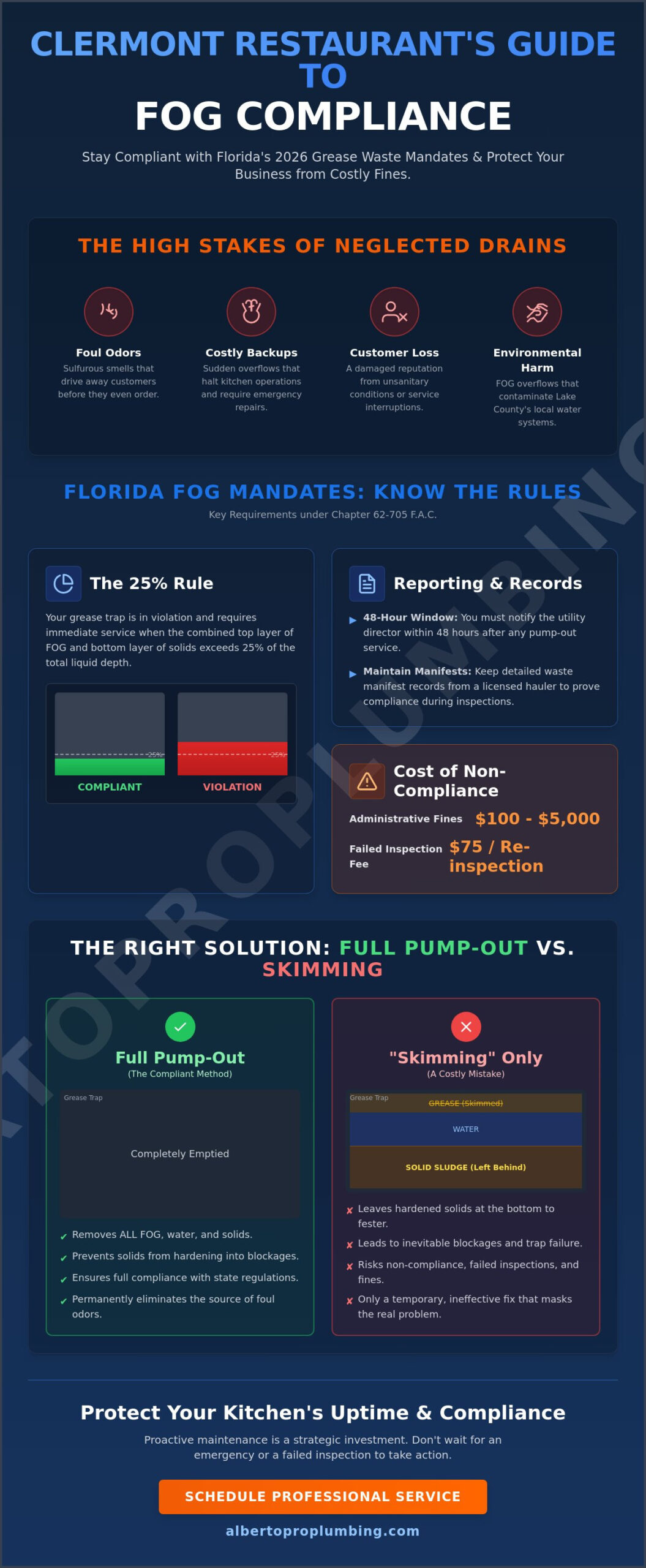
Choosing the right service method is where many Clermont business owners unknowingly risk their infrastructure. There is a massive difference between “skimming” and a “full pump-out.” Skimming is a superficial process where a technician only removes the top layer of floating grease. It looks clean on the surface, but it is a shortcut that leads to long-term damage. A full pump-out involves the complete evacuation of every drop of liquid and every ounce of solid waste from the interceptor. For commercial drain cleaning Clermont FL to be effective, the tank must be completely emptied to allow for a proper inspection of the internal structure.
When you only skim the surface, you leave behind a thick layer of acidic sludge at the bottom of the tank. Over time, this sludge becomes highly corrosive. It eats away at concrete walls and metal components, leading to premature structural failure. This is why professional commercial drain cleaning Clermont FL must always include a total pump-out. By clearing the entire system, you ensure that your drain cleaning services actually protect your investment rather than just delaying a disaster. It is the only way to ensure the baffle is still intact and the tank is truly ready for another cycle of heavy use.
The Hidden Costs of Poor Maintenance
Poor maintenance carries a heavy price tag that goes beyond the service fee. When sludge builds up, it reduces the tank’s effective volume. This causes grease to bypass the trap more frequently, leading to constant emergency calls for downstream clogs. You might also face the early replacement of your entire interceptor tank, which is a massive capital expense. Don’t forget the impact on your staff and brand. A failing system produces a nauseating odor that makes the kitchen an unpleasant place to work. Those smells can quickly seep into the dining room, driving away the customers you worked so hard to attract.
Specialized Equipment for Commercial Drain Cleaning
A bucket and a shop-vac won’t cut it for a commercial-grade kitchen. True professional service requires high-capacity vacuum trucks capable of pulling heavy solids from the bottom of deep tanks. During a standard professional visit, we often use hydro-jetting. This process uses high-pressure water to scour the inlet and outlet lines, ensuring no residual grease is left to start a new clog. Finally, professional scraping is a key step. We use specialized tools to remove hardened grease from the tank walls. This returns the unit to a “like-new” state that is easier to inspect and maintain for the long haul.
Creating a Compliant Maintenance Schedule for Your Clermont Business
Every commercial kitchen in Lake County operates under the “25% Rule.” This regulatory standard dictates that once the combined volume of fats, oils, grease, and solids reaches one quarter of your interceptor’s total capacity, it must be pumped. Waiting longer than this doesn’t just risk a clog; it puts you in direct violation of Clermont’s environmental codes. For most full-service restaurants, this threshold is reached every one to three months. However, your specific menu plays a huge role in this timing. A local BBQ smokehouse or a fried chicken specialist will naturally require more frequent commercial drain cleaning Clermont FL than a bakery or a sandwich shop that deals primarily with cold prep.
To extend the time between professional visits and protect your plumbing, your staff should follow a daily “dry cleanup” routine. Train your team to scrape every plate and pot into the trash before they ever reach the three-compartment sink. Use high-quality sink strainers to catch food particles, and never allow fryer oil to be poured down the drain, even if it’s mixed with hot water. These small habits significantly reduce the grease load on your system, helping you avoid the $75 re-inspection fees that come with a failed city check.
Signs Your Commercial Drains Need Immediate Attention
You don’t always have to wait for an inspection to know something is wrong. Pay close attention to how your kitchen breathes. Slow-draining floor sinks or prep stations are the first warning signs that grease is narrowing your pipes. If you hear gurgling sounds from the drains when the dishwasher is running, it means air is struggling to move past a growing obstruction. In extreme cases, you might see visible grease or “scum” floating in your downstream sewer cleanout. If you notice any of these red flags, it’s time to schedule your commercial plumbing service before a backup forces a mid-shift shutdown.
Record-Keeping and Compliance Documentation
In Clermont, having a clean grease trap is only half the battle. You must be able to prove it. Florida law requires all food service establishments to maintain professional waste manifest records on-site for a minimum of three years. A manifest is a legal document provided by your licensed hauler that tracks the date of service, the amount of waste removed, and the final disposal site. When a Lake County inspector walks through your door, these papers are the first thing they’ll ask to see. At Alberto Pro Plumbing, we provide clear, digital proof of service for every visit. This ensures you can report your pump-out to the utility director within the mandatory 48-hour window and stay perfectly in line with local 2026 standards.
Partner with Alberto Pro Plumbing for Reliable Grease Management
Running a successful kitchen in Clermont means balancing a thousand moving parts at once. You shouldn’t have to spend your limited time worrying if your grease trap will pass an inspection or if a drain will back up during your busiest shift. At Alberto Pro Plumbing, we take that weight off your shoulders. As a local specialist deeply rooted in the community, we provide expert commercial infrastructure support and comprehensive plumbing services tailored to the specific needs of Lake County businesses. We aren’t just a service provider; we’re your neighbors who understand the local regulatory landscape and the high stakes of your operation.
Our team believes that professional commercial drain cleaning Clermont FL should be as non-intrusive as possible. We know that foul odors and messy workspaces can disrupt your staff and drive away customers. That’s why we commit to a tidy, odor-free service every time we visit. We work efficiently to ensure your kitchen stays operational and your environment remains pleasant for both your team and your guests. While reactive repairs are sometimes necessary, we always encourage proactive maintenance contracts. Staying ahead of the sludge is always more cost-effective than dealing with an expensive, mid-service emergency shutdown.
Our Comprehensive Commercial Cleaning Process
We don’t believe in shortcuts like skimming. Our process starts with the total evacuation of your interceptor, removing every gallon of liquid and every pound of solid waste. Once the tank is empty, we perform a thorough scraping of the interior walls to remove the waxy, hardened grease that standard pumping leaves behind. This allows our technicians to conduct a detailed visual inspection of your baffles, seals, and inlet/outlet pipes. We look for early signs of wear or corrosion that could lead to system failure. Finally, we ensure that all collected waste is transported and disposed of at certified Florida treatment facilities. This keeps you in perfect compliance with state environmental laws and 2026 standards.
Why Local Clermont Businesses Trust the Alberto Pro Team
Local owners choose us because we bring a disciplined, family-oriented approach to every job. We’ve built a reputation for reliability and rapid response across Lake, Polk, and Orange Counties. Whether your business is connected to the Clermont city sewer main or relies on a complex commercial septic system, we have the technical expertise to handle it. We take immense pride in our craftsmanship and our ability to provide peace of mind to fellow business owners. When you partner with us, you’re getting more than a plumber. You’re getting a dedicated team that treats your property with respect and works hard to protect your bottom line. Let us handle the drains so you can focus on what you do best: serving the Clermont community.
Secure Your Kitchen’s Future with Proactive Maintenance
Our team is here to make compliance simple and stress-free. As licensed and insured Central Florida experts, we provide 24/7 emergency support for commercial backups to keep your doors open when every minute counts. We also stand by our tidy service guarantee, ensuring we leave your kitchen as clean as we found it. Don’t wait for a gurgling drain or a surprise inspection to take action. Schedule your professional grease trap cleaning with Alberto Pro Plumbing today! We look forward to helping your Clermont business thrive with reliable, neighborly service.
Frequently Asked Questions
How often does a restaurant grease trap need to be cleaned in Clermont?
Most full-service restaurants in Clermont require grease trap cleaning every 1 to 3 months to stay compliant with local 2026 standards. This frequency ensures your system stays below the mandatory 25% FOG threshold. High-volume kitchens or those with grease-heavy menus, such as BBQ or fried food specialists, often need more frequent visits. Regular commercial drain cleaning Clermont FL prevents the heavy buildup that leads to expensive emergency calls and keeps your kitchen running smoothly.
What happens if I do not clean my commercial grease trap and miss an inspection?
Neglecting your grease trap can lead to state-level fines ranging from $100 to $5,000 per violation under Florida’s Chapter 62-705 F.A.C. Beyond financial penalties, the City of Clermont has the authority to terminate your water and wastewater service if violations aren’t corrected within 72 hours. You also risk a $75 re-inspection fee if your records or tank levels aren’t compliant during a surprise check by environmental inspectors.
Can I clean my own grease trap to save money for my business?
You cannot legally clean your own commercial grease trap in Florida. Florida Statute 403.0741 requires all food service establishments to use a licensed grease waste hauler for these services. Inspectors require a professional manifest as proof of proper disposal at a certified facility. Attempting a DIY cleaning doesn’t just risk a mess; it leaves you without the mandatory documentation needed to avoid heavy administrative fines.
How long does a professional grease trap cleaning take during business hours?
A professional grease trap cleaning typically takes between 45 and 90 minutes to complete. The exact time depends on the size of your interceptor and its location. Smaller indoor units are often faster, while large outdoor 1,500-gallon tanks require more time for a full pump-out and thorough wall scraping. Scheduling commercial drain cleaning Clermont FL during off-peak hours ensures your kitchen operations remain completely uninterrupted.
What is the 25% rule for grease trap maintenance and compliance?
The 25% rule is the regulatory standard stating that a grease trap must be pumped once it reaches 25% capacity of fats, oils, and grease (FOG). When the combined layer of floating grease and settled solids exceeds this limit, the trap loses its ability to separate waste from water. This allows raw grease to escape into the city sewer or your septic system, which is the primary cause of fatbergs and system-wide backups.
Does a grease trap cleaning include the pipes leading from the kitchen to the tank?
A standard pump-out focuses on the tank, but a comprehensive professional service should also include the inlet and outlet lines. We often use hydro-jetting to clear the pipes leading from your kitchen to the interceptor. This ensures that no residual grease is left to cause a secondary blockage. It’s a vital step for maintaining the health of your entire plumbing infrastructure and preventing slow-draining prep sinks.
Will professional grease trap cleaning get rid of the foul smell in my kitchen?
Yes, a full professional pump-out is the most effective way to eliminate foul kitchen odors. These smells are caused by the accumulation of acidic sludge and rotting food solids at the bottom of the tank. Unlike simple skimming, which leaves this sludge behind, a complete evacuation removes the source of the sulfurous gases. This keeps your kitchen smelling fresh and protects your brand’s reputation with your diners.
How do I know if my grease trap is full if I cannot see inside the tank?
Slow-draining sinks and gurgling pipes are the most common indicators that your grease trap is reaching capacity. You can also use a measuring device called a sludge judge to check the levels of FOG and solids without a full inspection. If you notice waste backing up into your floor drains or see grease in your downstream cleanouts, your system has already exceeded the safe 25% limit and needs immediate attention.