
What if the strange gurgling sound coming from your guest bathroom isn’t just a stubborn clog, but a warning that raw sewage is about to back up into your Central Florida living room? Recognizing blocked sewer line symptoms early is the only way to prevent a minor inconvenience from turning into a major disaster. It’s a stressful situation that leaves many homeowners feeling stuck between the fear of a messy flood and the uncertainty of repair costs. You likely already know that plumbing issues never happen at a convenient time, and wondering whether the problem is your responsibility or the city’s only adds to the pressure.
We’re here to help you gain clarity and regain control over your home. Our goal is to ensure you know exactly how to identify a main line failure before it causes thousands in water damage to your property. We’ll walk you through seven red flags you can’t afford to ignore, the immediate steps to take to prevent flooding, and how we use our expertise to fix the issue quickly. As your local specialists, we take pride in providing reliable solutions that keep your home safe and your yard tidy. By the end of this guide, you’ll have the technical knowledge and the confidence to handle any sewer emergency with ease.
Key Takeaways
- Understand the “trunk and branch” relationship of your plumbing to see why a main line blockage causes failures in every room.
- Identify the most critical blocked sewer line symptoms, such as multiple fixtures backing up and strange gurgling sounds, before a flood occurs.
- Learn the difference between simple soft clogs and severe structural issues like tree root intrusion or a collapsed pipe.
- Follow a specific emergency protocol, including shutting off your main water valve, to immediately halt sewage backups into your home.
- Discover how high-definition camera inspections pinpoint the exact cause of your sewer crisis while keeping your property clean and respected.
Understanding Your Main Sewer Line: The Trunk of Your Plumbing Tree
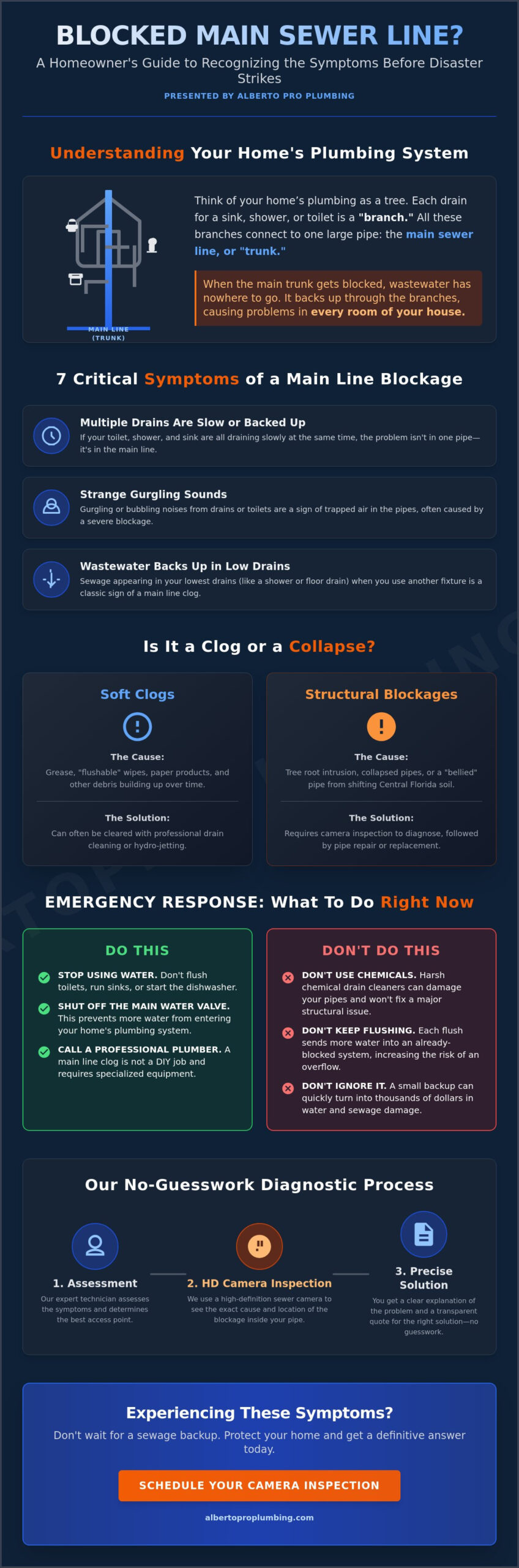
Think of your home’s plumbing as a tree. Each sink, shower, and toilet represents a small branch. These branches all feed into one large, central pipe known as the main sewer line, or the “trunk.” In a typical Florida home, this trunk is buried deep beneath your concrete slab or front yard. Its job is simple: carry every drop of wastewater away to the city’s treatment system or your private septic tank. When this main trunk gets obstructed, the “branches” in every room begin to fail. This is why a main line issue is far more serious than a simple clogged toilet.
While a localized clog only affects one fixture, a main line blockage causes a backup that travels the path of least resistance. Usually, this means sewage starts appearing in your lowest drains, like a walk-in shower or a floor drain. If you notice blocked sewer line symptoms appearing in multiple bathrooms at once, you aren’t dealing with a simple hair clog. You’re facing a potential sanitary sewer overflow that could lead to a messy and expensive cleanup. Recognizing these blocked sewer line symptoms early is the best way to protect your home from water damage.
How Central Florida Landscape Affects Sewer Lines
Living in Central Florida presents unique challenges for underground pipes. Our famous sandy soil, especially in areas like Lake County, is highly unstable. Over time, the ground beneath your home can shift or erode, causing your sewer pipe to “belly.” This dip creates a low point where solids collect, eventually forming a complete blockage. These “bellies” are common in our region and require professional diagnostics to identify.
Nature also plays a role. Florida Oaks and Palms have aggressive root systems that seek out moisture. Even a tiny hairline crack in an older cast iron or clay pipe is enough for a root to enter. Once inside, the root grows rapidly, acting like a net that catches grease and debris. Combine this with our high water table and heavy summer rains, and a compromised pipe can quickly become overwhelmed by external pressure, leading to a total collapse.
Sewer vs. Septic: Do the Symptoms Differ?
The red flags for a blockage are largely the same whether you’re on a city line or a septic system. However, the stakes change based on where that waste is headed. If you’re on a septic system, a backup might not be a pipe clog at all. It could be a sign that your tank is full or your drain field has reached the end of its lifespan. The pressure from a failing field can push water back toward the house, mimicking a standard blockage.
In many cases, what looks like a total system failure can be solved with a septic drain field rehab. This process restores the soil’s ability to absorb liquid without the massive cost of a full replacement. At Alberto Pro Plumbing, we serve Clermont and the surrounding communities by diagnosing both sewer and septic issues with precision. We make sure you know exactly where the problem lies before any digging starts, keeping your property tidy and your costs manageable.
7 Blocked Sewer Line Symptoms Every Homeowner Should Monitor
Most plumbing issues start small, but a main line failure is a different beast entirely. It’s helpful to think of your sewer line as a one-way street. When that street is blocked, traffic has nowhere to go but back toward your house. Recognizing blocked sewer line symptoms early can be the difference between a quick professional cleaning and a total home restoration project. Here are the most common red flags that suggest your main line is in trouble.
The Multi-Fixture Rule
One of the easiest ways to diagnose a main line issue is to look at how many rooms are affected. If your kitchen sink is slow but the rest of the house drains fine, you likely have a localized clog. However, if the kitchen sink, the master toilet, and the guest shower are all struggling at once, the “trunk” of your plumbing tree is blocked. This is the multi-fixture rule in action. It’s a clear signal that the problem is downstream in the main line rather than in a single pipe.
You should also pay close attention to your home’s lowest points. Gravity dictates that wastewater will always settle at the lowest exit available. This is why the guest bathroom shower or a laundry room floor drain often shows signs of trouble first. You might notice water bubbling up through the shower drain when you run the washing machine. This happens because of backflow. Backflow is the process where wastewater reverses direction due to a total blockage. If you see this happening, it’s a smart move to contact a local expert for a professional assessment before the situation worsens.
According to the Environmental Protection Agency on SSOs, blockages are a leading cause of sewer overflows which can release untreated waste into your home or yard. Other immediate warning signs include persistent “rotten egg” smells caused by trapped sewer gases and standing water inside your external sewer cleanout pipe. That cleanout pipe, usually located near your foundation, should be dry. If it’s full of water, the blockage is definitely between that pipe and the city main.
Secondary Signs: Your Yard and Pests
Sometimes the most telling blocked sewer line symptoms aren’t found inside the house at all. Your yard can act as a secondary diagnostic tool. If you notice a patch of grass that is suddenly much greener and lusher than the rest of your lawn, you might have a leaking or blocked pipe. The sewage acts as an unintended fertilizer as it seeps into the soil. While a green lawn sounds nice, it often points to a pipe that has cracked or collapsed entirely.
Pest activity is another subtle indicator. Cockroaches and rodents are naturally drawn to the moisture and debris found in sewer lines. If you have a sudden influx of these pests despite a clean home, they might be using a compromised sewer line as a highway to enter your property. These external signs often suggest a structural failure, like a collapsed line, rather than a simple soft clog caused by grease or hair. If you spot these issues, don’t wait for a total backup to occur.
Clog vs. Collapse: Identifying the Severity of the Blockage
Once you recognize blocked sewer line symptoms, the next step is determining if you’re facing a simple obstruction or a structural failure. Not all blockages are created equal. A “soft clog” usually consists of accumulated grease, hair, and household debris. These are the most common issues we see in Central Florida and are often resolvable with professional drain cleaning services. However, a “hard blockage” involves materials like tree roots or heavy mineral scale buildup. These require more aggressive methods, such as hydro jetting, to clear the line completely and restore full flow.
Structural failure is the most severe category. This includes pipes that have collapsed, cracked, or developed “bellies” due to shifting sandy soil. In many older Central Florida homes, the culprit is the pipe material itself. Cast iron pipes were the standard for decades, but they are highly susceptible to internal corrosion and “channeling,” where the bottom of the pipe literally wears away over time. When this happens, waste gets caught on the jagged metal, leading to constant backups. Identifying whether you have a simple clog or a total pipe collapse is essential for choosing the right repair method, whether that’s a quick cleaning or a more involved sewer line repair.
When to Suspect a Collapsed Line
A collapsed line is a structural emergency that requires more than just a plumbing snake. Keep an eye out for indentations or small “sinkholes” in your lawn directly above the sewer path. If a pipe is leaking underground, the water can wash away the supporting soil, causing the ground to cave in. In extreme cases, this erosion can even lead to cracks in your foundation slab or exterior walls. If you find yourself needing to clear the same clog every few months, it’s a major red flag. Frequent backups usually indicate a structural break or a root mass that has permanently compromised the pipe’s integrity.
The “Flushable Wipes” Myth
One of the leading causes of modern main line clogs is the use of “flushable” wipes. Despite what the packaging claims, these wipes don’t break down like traditional toilet paper. Instead, they snag on small imperfections or root intrusions inside the pipe, creating a massive, fabric-like dam that traps other debris. It’s important to remember that “flushable” is a marketing term, not a plumbing standard. To protect your main line and avoid blocked sewer line symptoms in the future, we strongly recommend a “toilet paper only” policy for every bathroom in your home.
Emergency Response: What to Do (and Not Do) Right Now
If you’ve identified blocked sewer line symptoms in your home, you’re likely in the middle of a high-stress situation. It’s easy to feel overwhelmed when water starts rising in your shower or a foul smell fills your hallway. However, the actions you take in the next few minutes will determine if you face a minor repair or a total home restoration. Stay calm and follow these immediate steps to protect your property and your family.
- Stop using all water immediately. Every time a toilet flushes or a sink runs, you’re adding volume to a system that has nowhere to go. That extra water will inevitably push its way back into your home through the lowest drains.
- Shut off the main water valve. This is a proactive way to prevent accidental water use by family members or guests. It’s much easier to remember not to use the sink when the faucet won’t turn on.
- Locate your sewer cleanout. Most modern Florida homes have a white, four-inch PVC pipe with a threaded cap located in the yard near the foundation. This is your primary diagnostic access point.
- Avoid DIY chemical cleaners. Never pour caustic chemicals down a suspected main line blockage. These liquids rarely reach the clog, and they’ll sit in your pipes eating away at the material. Even worse, they pose a severe burn risk to the plumber who eventually has to clear the line.
- Call for professional help. A main line backup is not a DIY project. You need 24/7 emergency plumbing repair to assess the damage and clear the line safely.
The Dangers of DIY Main Line Clearing
It’s tempting to rent a large plumbing snake from a retail store, but this often makes the problem worse. These machines are powerful and, if used incorrectly, can easily get stuck or break off inside a main line. Retrieving a broken cable requires expensive excavation that could have been avoided. Beyond the mechanical risks, you must consider the health hazards. Raw sewage contains harmful bacteria, parasites, and mold. Exposure is dangerous for anyone without professional training and protective gear. When roots are the cause, professional hydro jetting is the only safe way to scour the pipe walls without causing further structural damage.
Checking the Cleanout Safely
Checking your cleanout can tell you a lot about the location of the blockage. If you decide to open it, do so very slowly. If the line is backed up, there may be significant pressure behind the cap. Unscrewing it too quickly could result in a sewage spray. If you see standing water inside the cleanout, the blockage is located between that pipe and the city main or septic tank. If the cleanout is dry, the problem is likely inside your home’s foundation. It’s also helpful to know that homes built before 1978 may lack an external cleanout entirely. In these cases, we often have to access the line through a roof vent or by pulling a toilet.
If you’re currently seeing blocked sewer line symptoms and need a fast, reliable solution, contact our team at Alberto Pro Plumbing immediately for expert assistance.
Professional Diagnostics: How Alberto Pro Plumbing Solves Sewer Crises
When you encounter blocked sewer line symptoms, you need more than a quick fix. You need a permanent solution from a team that understands the specific challenges of Central Florida’s soil and infrastructure. We don’t believe in guesswork. Our diagnostic process uses advanced technology to identify the exact location and cause of your backup. Whether you’re dealing with a simple grease clog or a complex structural failure, we provide a clear path forward that prioritizes the safety and cleanliness of your home.
Our “Tidy Service” promise is the foundation of every call. We know that a sewer emergency is already a stressful, messy event. We make it our mission to ensure we don’t add to that burden. Our specialists use protective floor coverings and shoe covers, and we always leave your workspace in its original condition. We take deep pride in being the neighborly experts you can trust to respect your property as if it were our own.
Depending on our findings, we offer a range of professional remedies. For heavy root intrusion or scale buildup, we often recommend hydro jetting to restore your pipes to like-new flow. If our inspection reveals that your pipes are structurally compromised, we may discuss a whole home repiping. This long-term solution replaces outdated, corroded materials with modern alternatives, ensuring you won’t have to worry about these issues for decades to come. For ongoing peace of mind, our Home Protection Membership offers year-round monitoring to catch potential blocked sewer line symptoms before they turn into expensive disasters.
Camera Inspections: Seeing is Believing
We utilize high-definition, fiber-optic cameras to get a bird’s-eye view of your plumbing’s interior. These specialized cameras travel through your entire line, transmitting a clear signal to our monitors. You won’t have to take our word for it. We’ll show you the exact root mass, crack, or belly causing your trouble. We provide a digital recording of every inspection, which is vital for insurance claims or future home sale disclosures. We never suggest a major repair without providing you with visual proof and a detailed explanation of the fix.
The Alberto Pro Advantage in Central Florida
Our local heritage in Lake, Polk, and Orange County means we’re personally invested in the well-being of our community. We aren’t a cold, corporate entity. We’re a hardworking, family-oriented team that stands behind every job we do. Our upfront pricing model ensures you know the cost before we start, with no hidden fees or surprise charges, even for emergency response. We’re disciplined, respectful, and proud to serve our Florida neighbors. Contact Alberto Pro Plumbing for expert sewer diagnostics today and let us take the stress out of your plumbing emergency.
Take Control of Your Home’s Plumbing Health Today
Dealing with a main line backup is a stressful experience, but you don’t have to face it alone. By understanding the multi-fixture rule and keeping an eye out for blocked sewer line symptoms like gurgling drains or sewer smells, you’ve already taken the most important step toward protecting your property. Remember to stop all water use immediately if you suspect a blockage and avoid the temptation of using harsh chemical cleaners that can damage your pipes. Professional diagnostics are the only way to get a clear picture of what’s happening underground.
Our family-owned and locally operated team is proud to serve Central Florida with 24/7 emergency response and our signature Tidy Service Guarantee. We’ll use high-definition cameras to find the exact cause of your trouble so you can make an informed decision about your home. Schedule Your Sewer Camera Inspection with Alberto Pro Plumbing today to ensure your plumbing system remains reliable and safe for years to come. We’re here to help you get things back to normal quickly and professionally.
Frequently Asked Questions
Can a blocked sewer line fix itself?
A blocked sewer line won’t fix itself. Since a blockage is a physical obstruction like accumulated grease, flushed wipes, or invasive tree roots, it requires mechanical removal or professional cleaning to restore flow. Ignoring the issue often leads to a total pipe collapse or a messy sewage backup into your home. It’s best to address the problem as soon as you notice the first signs of trouble.
How much does it usually cost to clear a main sewer line in Florida?
The cost to clear a main sewer line depends on the severity of the clog and the equipment needed to fix it. Simple snaking is generally the most straightforward approach, while intensive hydro jetting for root removal requires specialized machinery and technical expertise. We provide upfront, transparent pricing after a camera inspection so you know exactly what to expect before any work begins on your property.
Will homeowner’s insurance cover a blocked sewer line?
Standard homeowner’s insurance policies typically don’t cover sewer line repairs or backups unless you’ve added a specific “Sewer Backup Coverage” rider to your plan. If the damage results from a sudden, accidental event, you might have a claim, but issues caused by poor maintenance or tree roots are usually excluded. Check your policy details or speak with your agent to confirm your specific coverage limits.
How do I know if the clog is in my pipes or the city’s pipes?
You can often determine the location of a clog by checking your external sewer cleanout. If you open the cap and see standing water, the blockage is likely between your house and the city main or septic tank. If the cleanout is dry but your house is still backing up, the problem is within your home’s internal plumbing. A professional camera inspection provides the most accurate confirmation for these blocked sewer line symptoms.
Can tree roots grow back after the sewer line is cleared?
Tree roots will absolutely grow back if the pipe is only cleared and not structurally repaired. Clearing the roots provides a temporary fix, but the tiny cracks that allowed them entry remain open. Over time, those roots will find their way back to the moisture inside your line. Permanent solutions include trenchless pipe lining or replacing the compromised section of the pipe to seal out future growth for good.
What is the fastest way to unclog a main sewer line?
Hydro jetting is the fastest and most effective way to clear a main sewer line. This process uses high-pressure water streams to blast through grease, scale, and invasive tree roots in a single pass. While a plumbing snake might only poke a small hole in a clog, hydro jetting scours the entire interior of the pipe. This method restores full capacity quickly and helps prevent immediate re-clogging.
Is it safe to stay in a house with a sewer backup?
Staying in a house with a significant sewer backup isn’t recommended due to serious health risks. Raw sewage contains harmful bacteria, viruses, and parasites that can cause illness. Additionally, the presence of sewer gas can be dangerous in enclosed spaces. If you can’t use your toilets or showers without waste entering your home, it’s safer to stay elsewhere until the line is professionally cleared and sanitized.
How often should I have my sewer lines professionally cleaned?
We recommend having your sewer lines inspected and cleaned every one to two years, especially if you live in an older home or have large trees near your plumbing. Regular maintenance helps you spot blocked sewer line symptoms before they lead to a full-blown emergency. Our Home Protection Membership makes this process easy by providing scheduled check-ups that keep your system running smoothly and your home safe.