
Could your beautiful Lake County property be hiding a swampy secret that doubles your construction budget? Many homeowners don’t realize that the cost to install a septic system in Lake County FL often depends more on your specific soil elevation and proximity to the water than the size of your home. It is common to feel overwhelmed by Florida Department of Health permits or the fear that a new drain field might fail after just a few heavy summer storms. You deserve a system that works reliably without draining your savings on unexpected mound requirements or specialized aerobic units.
We understand that uncertainty. This guide provides a transparent breakdown of what to expect in 2026, from the $75 state permit fees for new systems to the latest septic-to-sewer initiatives impacting our local community. We’ll walk you through the timeline for inspections and explain how to choose a system that stands up to Central Florida’s unique geography. You will gain a realistic budget and the confidence to ensure your property remains safe, clean, and compliant for years to come. Our goal is to help you avoid expensive mistakes while protecting the local environment we all call home.
Key Takeaways
- Learn how Lake County’s unique geography, from the Clermont hills to the high water tables in Leesburg, directly influences your total project budget.
- Get a clear breakdown of the cost to install a septic system in Lake County FL, including the 2026 permit fees required by the Florida Department of Health.
- Understand the pros and cons of concrete versus plastic tanks and why the drain field is the most critical investment for your property’s long-term health.
- Discover if your neighborhood is targeted for the voluntary septic-to-sewer initiative and what the annual assessment means for your property taxes.
- Find out why partnering with a local specialist ensures your installation meets strict environmental codes while keeping your yard tidy and protected.
Estimating the Cost of a New Septic System in Lake County
Planning for a new home or a major renovation in Central Florida requires a clear understanding of your infrastructure needs. The cost to install a septic system in Lake County FL reflects more than just the price of a tank. It involves professional site preparation, environmental compliance, and specialized labor that accounts for our unique local water table. While national averages provide a baseline, Florida’s strict Department of Environmental Protection standards often mean our local projects require more precision and specific materials than properties in other states.
Beyond the equipment, homeowners often encounter expenses that aren’t always obvious in the initial planning stages. Site clearing is a major factor, especially on wooded lots in areas like Mount Dora or Sorrento. If your soil doesn’t drain properly, you might need to haul in specific types of sand to create a raised mound. These logistical details, along with final landscaping to restore your property, are essential parts of a realistic budget. We focus on getting these details right the first time so you don’t face expensive corrections later.
Factors That Drive the Total Investment
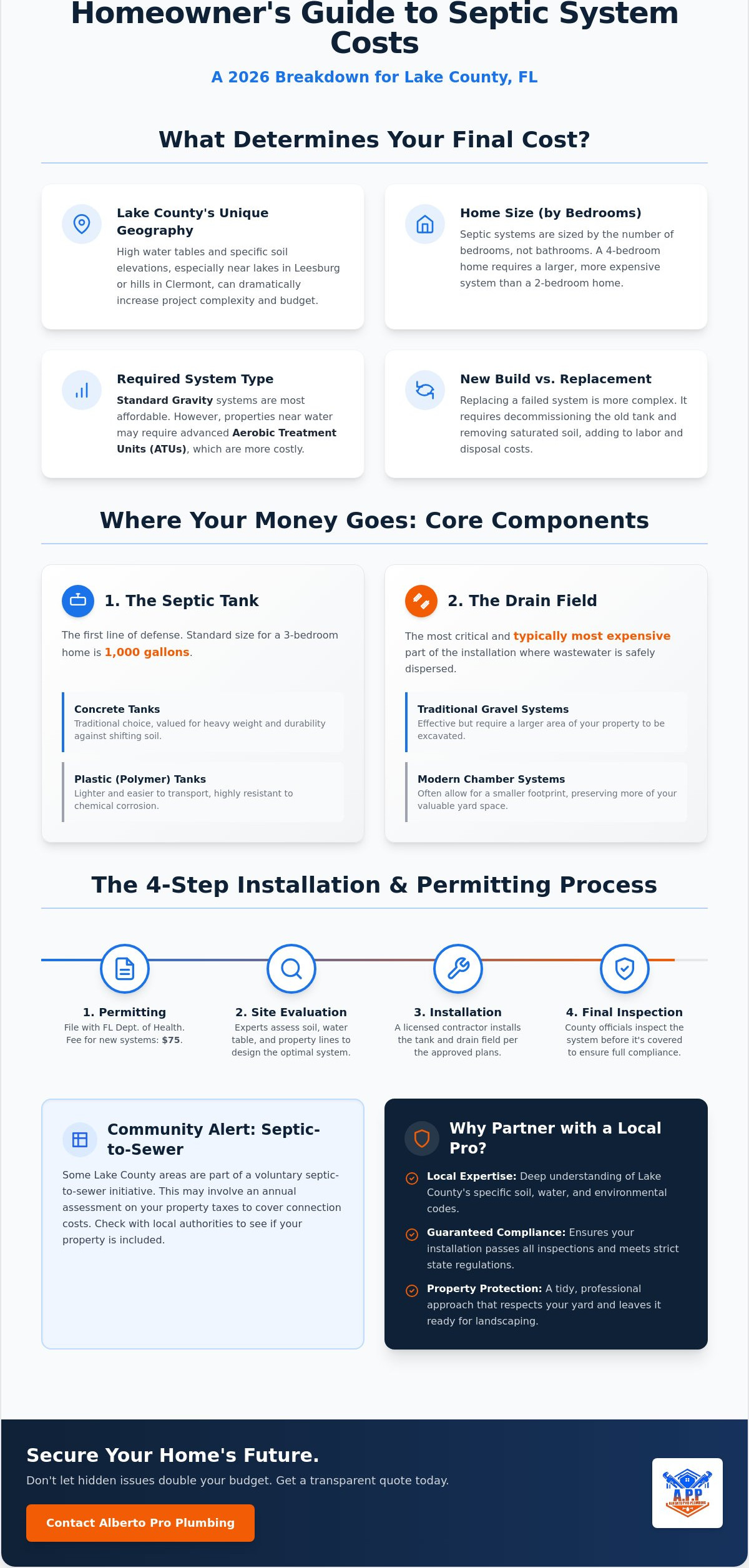
In Florida, septic systems are sized based on the number of bedrooms in your home, not just the bathroom count. A four-bedroom house generates more wastewater than a two-bedroom cottage, requiring a larger tank and a more extensive drain field. Understanding how septic systems work is helpful here; for instance, a standard gravity system is usually the most affordable option. However, properties near lakes or in low-lying areas often require advanced aerobic treatment units (ATUs) to protect water quality. These high-tech systems use oxygen to break down waste more efficiently, though they come with higher equipment costs and specialized maintenance requirements. Labor rates in the Central Florida market for 2026 also reflect the high demand for skilled technicians who understand our specific soil conditions.
New Construction vs. System Replacement
Replacing a failing system is often more complex than starting fresh on a new build. When we replace an existing system, the old tank must be properly decommissioned according to Lake County health regulations. This involves pumping out the waste, collapsing the tank, and filling it with clean sand or dirt to prevent future sinkholes. The cost to install a septic system in Lake County FL for a replacement also includes the labor-intensive process of removing old, saturated soil from a failed drain field. We prioritize a tidy service approach, ensuring that once the new pipes are in the ground, your yard is graded and ready for sod. This leaves your property looking as good as it did before the work began, respecting your investment and your neighborhood’s appearance.
Once the installation is complete and the heavy machinery is gone, you can learn more about Ray Lawns to see how professional lawn care experts approach the restoration and long-term health of residential turf.
The Core Components: Where Your Money Goes
Breaking down the cost to install a septic system in Lake County FL starts with understanding that you are building a mini wastewater treatment plant on your lot. It isn’t just about burying a tank; it’s about creating a system that protects your family and our local water supply. Every piece of hardware, from the inlet pipe to the final layer of sod, must comply with Florida’s Onsite Sewage Program. Choosing the right materials now prevents the stress of a system failure during a heavy Central Florida rainstorm.
Septic Tank Material and Capacity
The septic tank is your first line of defense. For most three-bedroom homes in Lake County, a 1,000-gallon tank is the standard requirement. You generally choose between pre-cast concrete and modern polymers like polyethylene. Concrete is the traditional choice, valued for its weight and durability against shifting soil. However, plastic tanks are becoming popular in harder-to-reach Central Florida lots because they are easier to transport and resist chemical corrosion. Excavation costs often fluctuate based on how deep the tank must be buried to achieve the proper pitch for gravity flow.
Drain Field Design and Materials
The drain field is where the real work happens, and it’s typically the most expensive part of the installation. Traditional systems use gravel trenches, but many local homeowners now opt for chamber systems like Infiltrator or synthetic aggregate bundles. These modern designs often allow for a smaller footprint, which is a huge plus if your lot has limited space. If you are dealing with a failing system, a full septic drain field rehab can sometimes restore functionality at a fraction of the cost of a total replacement.
Properties in low-lying areas like Leesburg or near our many lakes often face a high water table. This usually requires a lift station, which adds a submersible pump and a high-water alarm to your system. These parts are vital for moving effluent upward to a mound when gravity won’t do the job. The cost of “select fill” sand can also surprise many homeowners. This isn’t just any dirt; it’s a specific grade of sand that must be hauled in and tested for permeability. The labor to grade this material and ensure it meets local elevation codes is a significant part of the total investment. Our team takes pride in managing these logistics efficiently to keep your project on track. If you are starting a new build or fixing an old one, consulting with a neighborly expert helps you choose the right components for your specific soil.
Why Lake County Geography Impacts Your Installation Price
Lake County is famous for its rolling hills and over 1,000 lakes, but these scenic features create real engineering challenges for your wastewater system. The cost to install a septic system in Lake County FL isn’t a flat rate because a property in the Clermont hills has vastly different needs than a lot near the Harris Chain of Lakes in Leesburg. Elevation and soil health are the silent drivers of your project’s complexity. We see this every day; a system that works perfectly on one street might be impossible to build just a mile away without significant modifications.
If you are building on a slope in South Lake, the “Clermont Hills” factor comes into play. We must ensure that effluent doesn’t just run downhill into a neighbor’s yard or a protected waterway. This often requires specific placement or even a specialized pump system to move waste against gravity. Conversely, in low-lying areas, the challenge is keeping the system high enough to stay dry. A “perc test,” or percolation test, is the most important document you’ll own during this process. It measures how quickly your soil absorbs water. If the soil fails this test, you are looking at a more complex installation to meet state safety standards.
The High Water Table Challenge
Florida’s “wet season” is a major consideration for Lake County inspectors. The Florida Department of Environmental Protection (FDEP) requires a specific distance between the bottom of your drain field and the estimated seasonal high water table. In swampy or lakefront areas, the natural groundwater is often too close to the surface. To solve this, we often have to build a mound system, which is an above-ground drain field. These systems require a lift station and a pump to move waste from the tank up into the mound. While these additions increase the technical requirements of the build, they are essential for preventing drain field failure and protecting the groundwater your family relies on.
Soil Quality and Select Fill
Not all Florida dirt is created equal. While much of our county features sandy soil that drains well, we also have pockets of heavy clay that trap water. When the natural soil isn’t up to par, we have to bring in “select fill.” This is a specific type of clean, coarse sand that meets strict state requirements for filtration. Using cheap, unapproved soil is a mistake that can lead to a clogged system in under five years. We always insist on high-quality fill because it ensures your drain field stays breathable and functional. Our commitment to a tidy service means we manage these dirt deliveries carefully, protecting your driveway and landscaping while we work to secure your home’s infrastructure.
The administrative side of your project is just as critical as the digging. In Lake County, every installation must respect the delicate balance of our local ecosystem, especially for properties near the Clermont Chain of Lakes. The total cost to install a septic system in Lake County FL includes several specific permit fees mandated by the state. For 2026, a permit for a new system is $75.00, while a repair permit is $50.00. These fees ensure that every system meets the safety standards required to protect our shared groundwater. If your lot has unique elevation challenges or sits near a protected waterway, you should also budget for professional engineering plans to ensure your design is approved without unnecessary delays.
The Permitting Process in Lake County
The process begins with a formal application followed by a site evaluation by the Department of Health. Inspectors examine your soil morphology and water table levels to confirm that your proposed system is viable for your specific lot. Approval times in 2026 fluctuate based on seasonal demand, but working with a local expert helps keep the paperwork moving through the county office. Professional plumbing services are essential during this phase. We handle the technical sign-offs and ensure the final inspection goes smoothly. We know exactly what Lake County inspectors look for, which prevents the frustration of a failed inspection and the costly re-permitting fees that often follow.
Septic-to-Sewer: Future-Proofing Your Investment
Many neighborhoods in unincorporated Lake County are currently part of a voluntary septic-to-sewer initiative. This program targets areas within a Basin Management Action Plan (BMAP) to reduce nutrient pollution in our lakes and waterways. If your property is eligible, the county may cover the initial connection costs through specific funding programs. Once you are connected to the distributed wastewater treatment system, you will pay an annual assessment of $660, which is included in your property tax bill. If your current septic system fails while you are on a waitlist for sewer conversion, you must address the issue immediately to avoid environmental hazards and health department fines. We can help you determine if a modification permit, which costs $70.00, is a better temporary solution than a full new installation. If you are ready to secure your home’s infrastructure, contact our team for a professional consultation to explore your best options.
Choosing the Right Partner for Your Septic Installation
Selecting a contractor for your project is the most important decision you will make. While the total cost to install a septic system in Lake County FL is a significant factor, the cheapest quote often leads to the most expensive repairs down the road. You need a partner who understands local soil morphology and the specific expectations of Lake County inspectors. A contractor who offers a firm price over the phone without a site visit or a soil test is a major red flag. They cannot accurately estimate the cost to install a septic system in Lake County FL without seeing the elevation of your lot or testing the drainage quality of your dirt.
Local knowledge is your best insurance policy against system failure. A specialist who lives and works in Central Florida knows which neighborhoods have clay-heavy pockets and which ones sit on high water tables. This expertise allows them to design a system that works with your land rather than against it. We believe in building immediate trust through transparency. This means explaining the technical details of your drain field in a way that makes sense, ensuring you feel respected and understood throughout the entire process.
Questions to Ask Your Septic Contractor
- Are you licensed specifically for septic drain field work in Florida? This is a specialized field that requires different credentials than standard residential plumbing.
- How do you handle heavy machinery to minimize yard damage? Excavators and dump trucks can easily crush driveways or ruin irrigation systems if the operator isn’t careful.
- Do you provide a warranty on the drain field installation? A reputable specialist stands behind their craftsmanship because they know the system was built to last.
The Alberto Pro Advantage
We treat your home like it’s our own. Our team balances technical authority with a neighborly approach that makes a stressful situation much easier to handle. Whether we are responding to an emergency plumbing repair or planning a multi-phase septic installation, our priority is reliability. We are a family-owned business with deep roots in our community, and we take immense pride in our tidy service promise. This means we leave your property in its original condition, with your yard graded and ready for restoration once the work is finished.
You deserve a system that works perfectly and a contractor who values your property as much as you do. We combine disciplined labor with a genuine desire to be helpful, ensuring your home’s infrastructure is secure for the long haul. Don’t leave your property’s health to chance. Get a Professional Septic Evaluation Today and experience the difference that local expertise and personal accountability make for your Lake County home.
Secure Your Home’s Future with Local Expertise
Building or replacing a wastewater system is a significant investment that requires more than just a generic estimate. As we have explored, factors like the unique Clermont hills, high water tables in Leesburg, and strict Department of Health permits all influence the final cost to install a septic system in Lake County FL. Whether you are navigating a new construction project or considering a drain field rehab, the right technical guidance ensures your system remains reliable for decades. Understanding your soil’s morphology and the latest septic-to-sewer initiatives helps you make a choice that protects both your wallet and our local waterways.
Protecting these natural resources ensures that Central Florida remains a premier destination for outdoor recreation. If you want to experience the results of these conservation efforts firsthand, you can learn more about Bass Online and their guided fishing trips on the region’s most iconic lakes.
At Alberto Pro Plumbing, we bring Clermont-based local ownership and the specialized knowledge of Licensed Septic Drain Field Specialists to every job site. We understand the stress of household projects, which is why we offer a Tidy Service Guarantee to ensure your property is respected and left in its original condition. Don’t leave your home’s infrastructure to chance or unverified contractors. Request a Septic Installation Quote from Alberto Pro Plumbing to get a professional, transparent evaluation of your property’s needs. We are here to help you build a system you can trust.
Frequently Asked Questions
How long does it take to install a new septic system in Lake County?
The physical installation usually takes three to five days, but the entire process often spans two to four weeks. This timeline accounts for the initial site evaluation, the Department of Health permit approval period, and the final inspection by county officials. Weather delays during the Florida wet season can also impact the schedule, so it’s best to plan for a three-week window to ensure every stage is completed correctly.
Do I need a permit to replace just my septic tank?
Yes, you must obtain a modification permit from the Lake County Health Department even if you are only replacing the tank. For 2026, the modification permit fee is $70.00. Florida law requires this permit to ensure the new tank is properly sized for your home’s bedroom count and meets current environmental safety standards to prevent groundwater contamination.
What is the difference between a conventional and an aerobic septic system?
A conventional system relies on gravity and natural soil bacteria to treat waste, while an aerobic system uses an electric pump to introduce oxygen into the tank. Aerobic Treatment Units (ATUs) break down waste much faster and are frequently required for Lake County properties with high water tables or limited space. While an aerobic unit involves more moving parts, it provides a higher level of treatment before effluent reaches the soil.
Can I build a deck or shed over my septic drain field?
No, you should never build permanent structures like decks, sheds, or driveways over any part of your septic system. The weight of these structures can crush pipes and compact the soil, which prevents the drain field from filtering waste effectively. Keeping the area clear also ensures that technicians have immediate access for maintenance or future repairs without having to demolish your property.
How often should a new septic system be pumped in Florida?
Most residential systems in Central Florida should be pumped every three to five years to prevent solids from escaping the tank and clogging the drain field. This frequency depends on your household size and daily water usage. Regular pumping is the most effective way to protect your investment and avoid the high cost to install a septic system in Lake County FL as a premature replacement.
What happens if my soil fails the “perc test”?
If your soil fails a percolation test, you will likely need to install a mound system or an aerobic treatment unit. A failed test indicates that your natural soil is too heavy with clay or the water table is too high to filter waste safely. In these cases, we bring in “select fill” sand to create an elevated drain field that meets all Florida Department of Health safety requirements.
Are there any rebates available for upgrading my septic system in Lake County?
Lake County offers a voluntary septic-to-sewer conversion program that may cover the initial connection costs for eligible homeowners in specific environmental zones. While there aren’t always direct cash rebates for private upgrades, this program provides significant financial relief for those in Basin Management Action Plan areas. Homeowners should contact the county to see if their property qualifies for these specific infrastructure grants.
How do I know if my septic system is failing?
Common signs of failure include slow-draining sinks, gurgling pipes, or persistent sewage odors inside your home. You might also notice patches of unusually lush, green grass or standing water over the drain field area even when it hasn’t rained. If you notice these red flags, it’s vital to act quickly to prevent a total system collapse, which can significantly increase the eventual cost to install a septic system in Lake County FL.